Categories
Student Access

Student Support Is Workforce Development

Student support is workforce development because a worker’s pathway often begins before employment, before licensure, and before a finished credential. It begins with access.

When students can stay connected to practical education and training, communities are better positioned to build local skill, service capacity, and economic mobility. LFAS speaks about this carefully, without promising employment or any individual outcome.

The Access-to-Work Pathway

A student may need education access before they can reach completion, credentialing, licensure, employment, business ownership, or community service. Support belongs near the beginning of that pathway.

Why Practical Barriers Matter

Workforce development is often discussed in terms of employers and jobs. LFAS adds the student-access lens: books, tools, transportation, scheduling pressure, family responsibilities, and emergency gaps can all affect whether a person remains on the path.

Why Donors Should Care

A donor who supports student access is helping build the human foundation of workforce participation. The gift should be stewarded with humility, privacy, documentation, and clear limits.

Related LFAS Paths

Reference Points

Public Boundary

LFAS does not guarantee scholarship support, emergency support, admission, graduation, licensure, employment, donor participation, tax treatment, legal outcome, financial outcome, or any specific benefit. This article is public information, not legal, tax, financial, enrollment, or professional advice.

Categories
Student Access

Dignity Before Debt

Dignity before debt means students deserve clear support, honest language, and practical options before financial pressure becomes shame, silence, or confusion.

LFAS does not provide financial advice. LFAS can, however, help the public understand why student-support systems should reduce confusion and protect dignity.

Why Dignity Comes First

Students often carry private financial pressure quietly. A dignity-centered support model avoids blame and makes it easier to ask for information, review options, and understand boundaries.

Debt Awareness Is Not Debt Advice

Public education can explain the difference between grants, scholarships, work-study, loans, and private support. It should not tell any student what financial choice to make without qualified review.

How Donors Can Help

Donors can help make support available before students feel forced into rushed decisions. Responsible support gives students more room to communicate, document needs, and stay connected to school pathways.

Related LFAS Paths

Reference Points

Public Boundary

LFAS does not guarantee scholarship support, emergency support, admission, graduation, licensure, employment, donor participation, tax treatment, legal outcome, financial outcome, or any specific benefit. This article is public information, not legal, tax, financial, enrollment, or professional advice.

Categories
Student Access

The Real Cost of Stopping Out

Stopping out is not only a school event. It can affect confidence, family schedules, workforce momentum, and a student’s belief that education is still within reach.

LFAS uses careful public language around stopping out because every student story is private unless shared with consent. The foundation can still educate the public about why continuity matters.

A Stop Can Become More Than a Pause

When a student leaves a program temporarily, the return path can become harder. Practical issues may compound: time, money, transportation, family care, work schedule, confidence, and paperwork.

Why Support Should Arrive Early

Student support is strongest when barriers are noticed before they become permanent exits. This does not mean every barrier can be solved. It means the support system should be ready, documented, and humane.

The Donor Role

Donors can help build the support capacity that protects continuity: emergency aid, tools, books, transportation, and clear communication. Donors should also see that LFAS does not sell certainty.

Related LFAS Paths

Reference Points

Public Boundary

LFAS does not guarantee scholarship support, emergency support, admission, graduation, licensure, employment, donor participation, tax treatment, legal outcome, financial outcome, or any specific benefit. This article is public information, not legal, tax, financial, enrollment, or professional advice.

Categories
Student Access

Why Small Scholarships Can Help Protect Completion

Small scholarships matter because many education interruptions are practical, not philosophical. A student may still have the will to continue but lose momentum because of a book, tool, transportation, schedule, or continuity gap.

LFAS does not treat small support as small in meaning. A modest gift can become part of a larger support structure when it is documented, bounded, and connected to student dignity.

Completion Pressure Is Practical

Students may face small-dollar problems that create large interruptions. The public lesson is simple: access support should pay attention to the real points where students can be pushed off track.

  • A missing tool can delay participation.
  • A transportation issue can interrupt attendance.
  • A short-term emergency can create long-term loss of momentum.

What Donors Are Funding

Donors are not purchasing an outcome. They are supporting access, continuity, and dignity through a nonprofit pathway that should remain honest about limits.

How LFAS Keeps It Responsible

LFAS should explain support categories, keep records, respect privacy, and avoid public claims that a gift produces a guaranteed result. The right message is support, not certainty.

Related LFAS Paths

Reference Points

Public Boundary

LFAS does not guarantee scholarship support, emergency support, admission, graduation, licensure, employment, donor participation, tax treatment, legal outcome, financial outcome, or any specific benefit. This article is public information, not legal, tax, financial, enrollment, or professional advice.

Categories
Student Access

Scholarship Is Access Infrastructure

Scholarship support is not only a gift to one student. It is access infrastructure: a practical support system that can help a student stay connected to education, training, completion, and future work.

Louisville Fund A Student Foundation frames scholarship support as a community responsibility with public boundaries. The goal is to reduce practical barriers, protect student dignity, and steward donor intent without promising any specific award or outcome.

What Access Infrastructure Means

Infrastructure is what makes movement possible. In education, access infrastructure may include tuition support, books, tools, transportation help, emergency continuity support, and clear documentation.

  • Students need more than encouragement when practical barriers appear.
  • Donors need a clear stewardship path before they give.
  • Communities benefit when education access is treated as serious public work.

Why Donor Trust Matters

Scholarship support is stronger when donors can see the mission, the boundaries, and the reason for each support category. Public clarity reduces confusion and protects both students and supporters.

How LFAS Holds the Boundary

LFAS can help explain support pathways, but support decisions must remain documented, careful, and nonprofit-safe. Public pages should never imply automatic aid, guaranteed eligibility, or private student disclosure.

Related LFAS Paths

Reference Points

Public Boundary

LFAS does not guarantee scholarship support, emergency support, admission, graduation, licensure, employment, donor participation, tax treatment, legal outcome, financial outcome, or any specific benefit. This article is public information, not legal, tax, financial, enrollment, or professional advice.

Categories
Education Opportunity Student Support

Why Students Need More Than Encouragement: The Lost Majority and the Work of Restoring Continuity

Educational opportunity is not created by encouragement alone. Students also need continuity: stable routines, documented progress, practical support, and environments that help intention become repeatable action.

That is why Di Tran’s new book, The Lost Majority: Why Modern Life Breaks Human Momentum—and How to Restore Structure, Meaning, and Value, deserves attention from anyone who cares about student success and long-horizon upward mobility.

The book’s relevance to student support

The book argues that many people are not failing simply because they lack desire. They are failing because the structures around them are unstable. When schedules break, guidance is inconsistent, proof is weak, and life becomes reactive, the ability to keep going erodes.

For students — especially those balancing work, family, transportation, finances, and uncertainty — continuity is not a luxury. It is a form of support.

What restoration looks like in practice

  • Clear processes instead of confusion
  • Attendance support instead of shame
  • Documentation instead of ambiguity
  • Coaching that leads to completion
  • Pathways that turn effort into credential, work, and dignity

The Lost Majority helps explain why these supports matter. It reframes structure as mercy rather than control, and continuity as a real form of empowerment.

Where to Read, Watch, and Follow

For organizations that care about educational access, this book is a reminder that the most compassionate systems are often the ones that help people continue.

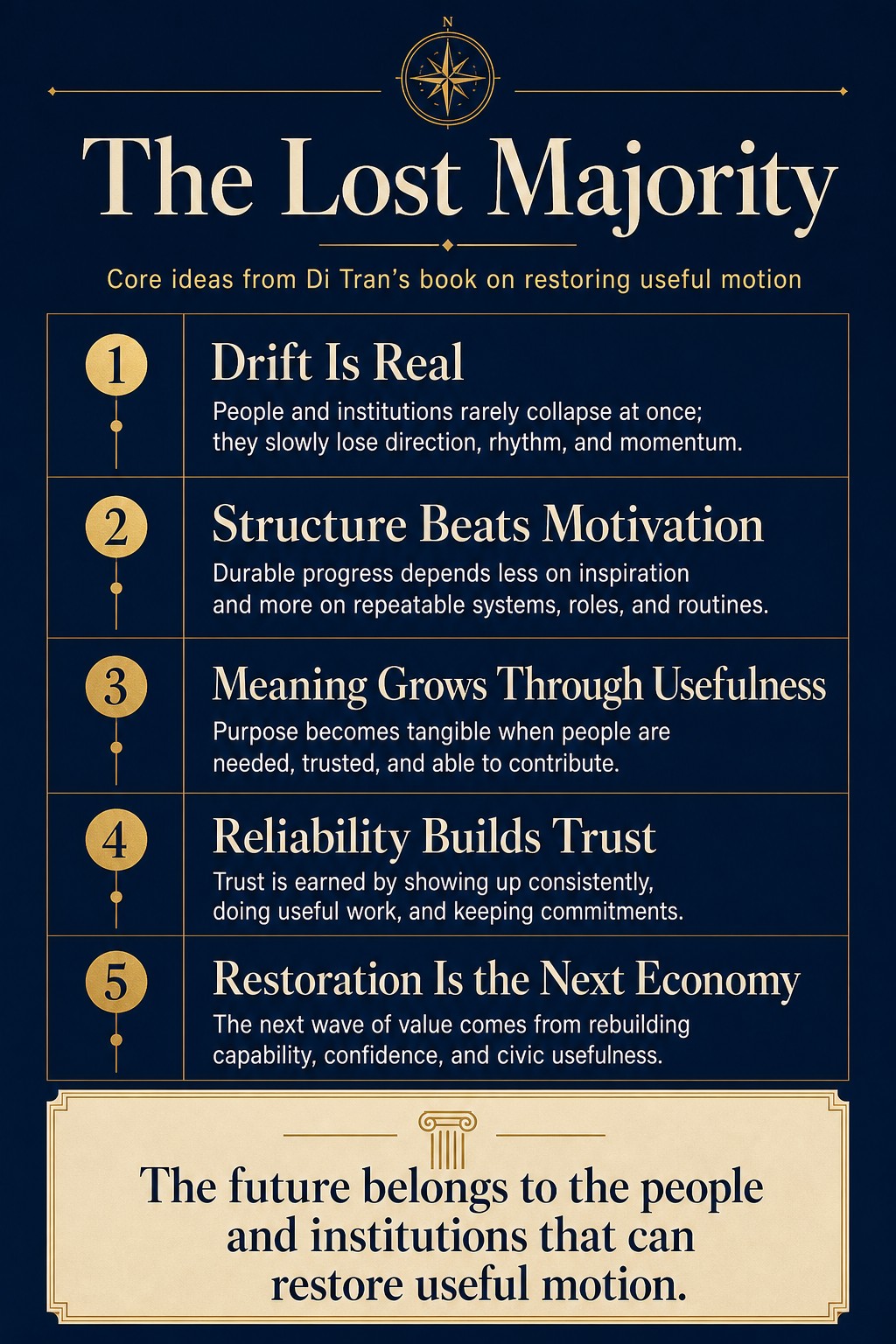
Infographic summarizing the core ideas of The Lost Majority by Di Tran.
Infographic: five core ideas from The Lost Majority by Di Tran.

LFAS Continuity Path

The foundation lesson behind this reflection is practical: students often need clear next steps, dignity, documentation, and continuity before they can keep moving. LFAS treats that support as a trust responsibility, not as a promise of individual results.

Public Boundary

This page is public education and mission context. LFAS does not guarantee aid, scholarship awards, enrollment, graduation, licensure, employment, income, tax treatment, debt-free outcomes, public benefits, or any individual student result.

Categories
Scholarship Impact

Scholarship as Protective Infrastructure for Human Potential

Scholarship should not be understood as charity alone. At its best, it is protective infrastructure for human potential.

When a student lacks funds, the problem is rarely only financial. The absence of support can slow entry into training, increase dependency on harmful debt, interrupt momentum, and push capable people away from lawful educational and workforce pathways. Small amounts of support, when well-timed and responsibly structured, can therefore change far more than a tuition balance. They can preserve a future.

This is why scholarship work should be framed with institutional seriousness. It is not simply generosity. It is an intervention into opportunity structure. It protects a student’s ability to continue, complete, qualify, and move toward contribution. In many families, that effect extends beyond one person. It stabilizes households, restores confidence, and creates examples that younger relatives can follow.

Louisville Fund A Student Foundation exists inside that logic. The goal is not only to give. The goal is to widen lawful access to advancement while preserving dignity. Scholarship should not infantilize recipients. It should honor effort, reduce unnecessary barriers, and strengthen the bridge between aspiration and disciplined follow-through.

This work also matters publicly. Communities that invest in students are not merely supporting individual dreams. They are investing in workforce capacity, civic stability, and intergenerational resilience. A student helped at the right moment may become a licensed professional, a business owner, a parent with greater economic security, or a future supporter of others.

For that reason, scholarship should be discussed in the language of infrastructure, stewardship, and public value. It belongs within a larger ecosystem of institutions that teach, document, advocate, and serve. Education, policy, and community support are strongest when they reinforce one another.

A scholarship does not eliminate the need for discipline, standards, or effort. It simply keeps the path open for someone prepared to walk it. That is often the difference between stalled potential and realized contribution.

This essay is offered for public-information and philanthropic reflection purposes. It does not constitute financial, legal, or tax advice for any specific donor, recipient, or organization.

How LFAS Keeps Support Responsible

Protective scholarship infrastructure depends on clarity as much as generosity. LFAS now keeps separate public pathways for donor stewardship, student dignity, privacy, transparency, and donation-path clarity so support can be handled with discipline rather than impulse.

LFAS does not promise or guarantee scholarship awards, admission, graduation, licensure, employment, tax treatment, financial results, or any specific outcome. The foundation’s public role is to support access, transparency, documentation, and dignity within responsible nonprofit boundaries.

Categories
Scholarship Impact

Scholarship as Economic Infrastructure: Why Funding One Student Can Change an Entire Family’s Trajectory

The most disciplined philanthropy does not confuse generosity with impact. It asks a harder question: where can one dollar of support produce the greatest lawful, durable change in human trajectory? In many communities, one of the strongest answers lies in targeted educational access—especially where modest funding can move a student into a regulated profession, stable earnings, and eventually entrepreneurial possibility.

Scholarship, in that setting, is not a sentimental gesture. It is economic infrastructure at human scale.

The logic is straightforward. A student who cannot access training remains blocked not because of lack of will, but because the bridge between aspiration and entry is missing. When that bridge is built responsibly—through tuition support, fee assistance, licensure preparation, or practical educational enablement—the resulting effect is rarely isolated to one person. The impact often ripples through children, spouses, parents, households, and local business ecosystems.

This is particularly true in workforce-linked fields. Where training leads toward lawful professional participation, scholarship funding can produce unusually direct conversion from assistance to income generation. The support is not merely consumptive. It can become enabling capital.

That matters in the current economic environment. Many aspiring students are adults. Many support families. Many come from immigrant or low-income households. Many cannot pause life long enough to wait for slow or abstract opportunity. They need an access mechanism that respects both urgency and dignity.

That is why scholarship platforms should be judged not only by heart, but by architecture.

A strong scholarship platform should identify real educational barriers, direct funding toward pathways with credible completion logic, preserve transparency about use of funds, and emphasize outcomes without reducing students to statistics. Donor trust grows when compassion is matched by discipline. Communities support institutions that can demonstrate both moral seriousness and operational clarity.

For Louisville Fund A Student Foundation, this is the opportunity. The foundation can position itself not merely as a charitable vehicle, but as a local access-capital institution—one that helps convert community generosity into lawful mobility. That framing is stronger, more durable, and more legible to serious donors, grantmakers, and civic partners.

Importantly, scholarship support should never be romanticized as a cure-all. It is one part of a larger ecosystem. Students still need quality instruction, regulatory alignment, scheduling support, community encouragement, and often a credible pathway into work. But where those elements exist, scholarship can become the catalytic piece that changes what is possible.

In policy terms, this is exactly why education access deserves philanthropic attention. Not every intervention creates multiplying effects. Scholarship tied to practical, regulated, workforce-facing education often does. It can help move a person from economic fragility toward self-support. And once a household stabilizes, the surrounding community gains as well.

The highest purpose of philanthropy is not image. It is well-placed enablement. Funding one student may not look dramatic at first glance. But in the right institutional environment, it can change the economic grammar of an entire family.

That is not charity at its weakest. It is stewardship at its strongest.

LFAS Donor and Student Pathways

Readers who want to turn this infrastructure idea into practical support can start with the current LFAS trust pathways. These pages explain donation routing, stewardship expectations, student privacy, and no-promise boundaries.

LFAS does not promise or guarantee scholarship awards, admission, graduation, licensure, employment, tax treatment, financial results, or family outcomes. Student support is one carefully documented part of a larger education and workforce-access ecosystem.

Research & Information Disclaimer

This publication is provided for educational, research, and public-information purposes only. It reflects institutional analysis based on publicly available information, practical experience, and internal interpretation as of the publication date. It does not constitute legal advice, tax advice, investment advice, or a guarantee of regulatory, financial, or operational outcomes. Readers should consult qualified legal, financial, regulatory, or other professional advisors before acting on matters discussed herein.

References
Categories
Uncategorized

Drop the ME and Focus on OTHERS: Founder Reflection for Student Support

LFAS Context

This founder reflection is preserved because LFAS is built around an others-first student-support ethic: community generosity should become practical access, dignity, and stewardship. The current LFAS website now separates that values story from active donation, student inquiry, privacy, and transparency pathways.

This article is not a scholarship offer, fundraising commitment, tax statement, legal statement, or promise of any educational, licensing, employment, financial, or personal outcome.

Current LFAS Support Path

This legacy article is preserved as part of the Louisville Fund A Student Foundation public record. For current student-support, donation, stewardship, privacy, and transparency guidance, use the updated LFAS trust pathways below.

LFAS does not promise or guarantee scholarship awards, admission, graduation, licensure, employment, tax treatment, financial results, or any specific outcome. Support is considered within available resources, documentation, stewardship standards, and applicable nonprofit boundaries.

Drop the “ME” and Focus on the “OTHERS” – by Di Tran, CEO of Louisville Fund A Student Foundation (501c3 – Non-Profit Organization)

CHAPTER 2 SNIPPET

FOCUS ON THE GOOD YOU PROVIDE TO OTHERS

From the time I was a kid through the present, I have always announced that I was the luckiest person in the world, to have been born by and well cared for by my parents, especially my mom, the number one “other” in my life. I believe that it was God’s plan for me to exist and to give me such a special mother, who was been a teacher, an idol, a mentor, and a great caretaker. She made the most of the worst and gave me the best out of life. She looks like a simple woman, small and short in physical stature, and easily underestimated by many. But oh-my-lord, is she ever inwardly explosive when it comes to the good deeds she wants to create for her family, her extended family, and her community! So, this kid from Vietnam, from the rural countryside of a third-world nation, understood the bad conditions he was living in, but never felt it because of the vast amount of love and care that he received from family members, and especially Mom. I learned to recognize one thing from all my experience up to this point: What you do for others is all that matters and nothing else, so we must choose to always provide the best and most valuable opportunity for others that we possibly can.

There’s a saying that my mom always tells me, “Son, a piece of bread that is given to a person when he is hungry is worth more than a big meal given to one who is full. One dollar given to those who do not have any money, is worth more than thousands of dollars given to those who have enough.” The consistency in giving and adding value to others in need is worth more than a one-time large gift. “Son, there is an element of self-satisfaction, self-happiness, and self-motivation that this involves.” She stressed that acts done for others are hundreds of times more self-satisfying than doing for oneself; be others focused. Growing up, I watched her give gifts to everyone who came by our house. There was a potato, her only food, which she cut in half and gave to a biker who rode her around. When there was a bag of bananas, she immediately distributed one to each of her team members. People, in turn, often gave her giftbags of fruit; however, these never lasted more than an hour before she had already distributed it. I watched her give without much thought, carrying out a “must do” mission, even when she had very little. I grew up watching Dad get angry because of these actions. “Damn it, you keep giving everything away, and not keeping anything for our family to eat. Give it some thought next time,” he yelled at Mom in a behind-the-scenes conversation that I often overheard. Interestingly, each time she would smile and respond, “Dad, they need it more than we do.” Of course, Dad did cool down, but he could not stop her from giving away whatever she had.

As I better understand this now, I call it “human engineering to happiness” from my personal perspective. According to books such as The Power of Your Subconscious Mind by Joseph Murphy, I learned that it is like brainwashing ourselves. It involves training our subconscious mind, the main part of our brain that reasons and pushes us to do everything we do, even when we don’t know why. In this case, Mom brainwashed herself and others around her, and so I was trained and witnessed and experienced this (brainwashed) via Mom’s giving as a guiding principle of life. This makes the action of giving easier than most tasks that I deal with in life. And once I lived through the happiness of giving unconditionally, I untapped a compulsion to do it more. Interestingly, the same results have occurred throughout my life, as my experiences duplicate those of her life. That is to say that people around me started to give things to me in services, products, assistance, and mentorships. “You cannot give without first focusing on others and being less worried about yourself, Son. “The more you give, the more you gain in return, often from other sources,” Mom explained.

“Expectation is the source of worry, unhappiness, and uncertainty. That’s why giving unconditionally matters more, because that’s when you give without expectation,” Mom explained. No expectations give the human mind the freedom to enjoy the giving experience and seek happiness in other people’s happiness when they receive your gift. This fact was confirmed by Dale Carnegie in his book, How to Stop Worrying and Start Living. What is of greater interest to me is that Mom always acted, and then explained her actions to her children. Often, she would take us with her on business trips, so we could witness her activities and see how she treated other people when making business deals. Mom is not the type who speaks theory; rather she acts on the theory and then explains it using examples of her actions. Throughout my life, this resonated the most with me; actions speak louder than words. “Do it first, Son. Do it. For anything you think is good for others, do it first, and then explain it. If you make one person happy through one action, do it again for many, and then increase that each day forward. Trial and error. I learned through doing.” I watched her read a lot, but these were always technical books and business product and service books; they were never books about theories of life principles. “To learn and not act is useless. It is worse than those who never learned. Once you know, you must act on what you know.” Mom pushed our boundaries of thought on this topic.

References

Categories
Scholarship

Rare Bourbon Fundraising Archive: Student Support Campaign

Archive Note: Historical Bourbon Fundraising Campaign

This page is maintained as a historical campaign archive. Current LFAS support should be routed through the updated donation and stewardship pages, which explain student access, donor privacy, receipt language, no-goods-or-services boundaries, and no-guarantee standards.

Nothing on this archive page promises scholarship awards, admission, graduation, licensure, employment, tax treatment, financial outcome, donor benefit, or product availability. Donors should use current LFAS guidance before making support decisions.

Current LFAS Support Path

This legacy article is preserved as part of the Louisville Fund A Student Foundation public record. For current student-support, donation, stewardship, privacy, and transparency guidance, use the updated LFAS trust pathways below.

LFAS does not promise or guarantee scholarship awards, admission, graduation, licensure, employment, tax treatment, financial results, or any specific outcome. Support is considered within available resources, documentation, stewardship standards, and applicable nonprofit boundaries.

Original Historical Campaign Listing

Weller Special Reserve bottle shown in historical LFAS bourbon fundraising campaign

$375 or more Donation for a gift of Buffalo Trace Bourbon W. L. WELLER SPECIAL RESERVE Big Bottle 1.75L

Blantons Original Single Barrel bottle shown in historical LFAS bourbon fundraising campaign

$375 or more Donation for a gift of Buffalo Trace Bourbon BLANTON’S ORIGINAL SINGLE BARREL BOURBON WHISKEY

Colonel E H Taylor Small Batch bottle shown in historical LFAS bourbon fundraising campaign

$285 or more Donation for a gift of Buffalo Trace Bourbon Colonel E.H. Taylor Small Batch Bourbon Whiskey

Colonel E H Taylor Single Barrel bottle shown in historical LFAS bourbon fundraising campaign

$785 or more Donation for a gift of Buffalo Trace Bourbon Colonel E.H. Taylor SINGLE BARREL Bourbon Whiskey