Categories
Community Education Student Support

Student Support Means Understanding Cost, Work, Taxes, And Benefits

This is public education for students and families. It is not legal, tax, benefits, Medicaid, insurance, immigration, or financial advice.

Students and working families often experience education, work, taxes, health coverage, and paperwork as separate problems. In real life, they are connected. A student may choose a school, enter a licensed trade, begin work, and then face questions about 1099, W-2, taxes, Medicaid, insurance, and family stability all at once.

Access is not only tuition help. Access is understanding the paperwork that follows a student into real working life.

Why Families Need Plain-Language Support

For low-income and working families, one decision can affect several systems: school cost, payment plans, work status, taxes, Medicaid, Marketplace coverage, transportation, childcare, and household budgeting. A form may look simple, but the consequences can last for years.

Louisville Fund A Student Foundation views this as a student-support issue. Families need clear education before confusion becomes fear. They need written documents, source links, translation support, and encouragement to ask qualified professionals when the question becomes legal, tax, benefits, or insurance-specific.

A Family-Support Checklist

  • Ask for the full written cost before committing to any education program.
  • Understand whether money is a grant, scholarship, loan, discount, payment plan, or family payment.
  • When entering work, ask whether the structure is W-2, 1099, booth rental, or another model.
  • If income changes, ask a qualified benefits advisor how Medicaid or Marketplace coverage may be affected.
  • Keep written records: school documents, pay records, tax forms, benefit notices, and important communications.
  • Do not rely on rumors when official sources and qualified advisors are needed.

The goal is not to scare students. The goal is to help families move forward with more dignity, more written clarity, and less preventable harm.

Related Reading

Vietnamese infographic listing five community education points about 1099, W-2, FLSA economic reality, payroll cost, and Medicaid cliff for nail salons
Community education summary. Each specific situation should be reviewed with the appropriate CPA, attorney, payroll professional, benefits advisor, or licensing authority.
Categories
Student Support

Helping Students Understand Aid Before Debt

Student support is not only about helping someone find money. It is also about helping someone understand what kind of money it is.

A grant, loan, scholarship, payment plan, and discount are not the same thing.

As student-loan rules change nationally, families need more than headlines. They need plain-language help before they sign. A student may be approved for aid and still not understand the long-term obligation. A parent may want to help and still not understand what debt will follow the family.

Support Should Reduce Confusion

Louisville Fund A Student Foundation believes student access work must preserve dignity and clarity. A support system should not push students into commitments they do not understand. It should help students ask better questions and compare written cost before commitment.

  • Is the money a loan or a grant?
  • Does it have to be repaid?
  • Is there interest?
  • What is the total cost of the program?
  • What happens if the student withdraws or needs more time?
  • Are current documents available in writing?

Why LBA Matters To This Conversation

Louisville Beauty Academy’s lower-cost, written-document model gives families a practical example of how workforce education can be serious and more debt-conscious. That model matters because not every student needs the most expensive path to pursue a licensed career.

The Foundation Role

LFAS can support this public education lane by helping students and families understand documents, ask clear questions, and seek support without confusion. The long-term goal is not just access. It is responsible access.

Sources And Written-Control Notes

Infographic comparing a twenty thousand dollar beauty school cost with a six thousand two hundred fifty dollar Louisville Beauty Academy public cost example
Illustrative comparison for public education. Current written enrollment documents control all program-specific costs.
Categories
Donor Trust

How Donor Support Can Reduce Barriers Without Reducing Standards

How Donor Support Can Reduce Barriers Without Reducing Standards

A strong student-support model should not promise shortcuts. It should help remove avoidable barriers so students can meet real standards with more stability. That distinction matters.

Donor trust grows when the foundation communicates clearly: support is not a guarantee of enrollment, graduation, licensure, employment, or financial outcome. It is a structured way to help reduce friction for people pursuing practical advancement.

The foundation’s public voice should therefore be both warm and disciplined. It should invite generosity while protecting student privacy, donor confidence, and the seriousness of workforce education.

What This Means Practically

  • Use written clarity before verbal pressure.
  • Give people the next honest step without forcing the decision.
  • Let proof, service, and usefulness create trust over time.

Institutional Position

LFAS will continue developing student-support communication that is compassionate, practical, privacy-conscious, and clear about boundaries.

References and Related Institutional Context

  • LFAS donor stewardship promise
  • LFAS student dignity and privacy standard
  • 100-Day Elite Institutional Channel Calendar, 2026-06-01

This article is public education and institutional commentary. It is not legal, financial, medical, or individualized enrollment advice.

Categories
Student Access

Beauty School Without the Debt Trap and the Access Question for Practical Education

Beauty School Without the Debt Trap and the Access Question for Practical Education

Louisville Fund A Student Foundation exists around a simple public concern: access should be connected to dignity, clarity, and real pathways.

Beauty School Without the Debt Trap gives that concern a practical education frame. The book features Louisville Beauty Academy as a proof model for lower-cost, documentation-first, state-licensed beauty education.

Access Is More Than Opening the Door

A student does not only need a door. A student needs to understand what is behind the door.

What will this cost? What records matter? What does the state require? What happens if life interrupts school? What is the path from enrollment to hours, graduation, examination, licensure, work, and professional dignity?

When these questions are answered clearly, support becomes more meaningful.

Lower Cost Makes Support Go Further

A lower-cost model does not eliminate the need for support. Students may still face transportation, childcare, schedule, language, family, and financial pressure.

But when education is designed with cost discipline and written clarity, every responsible support dollar can travel further. Families can understand the pathway better. Donors and supporters can see the human value more clearly. Institutions can protect students with documents rather than vague promises.

A Humanized Access Doctrine

The access question should not be reduced to money alone. Real access includes written expectations, honest records, transparent cost, lawful training, licensure awareness, and human care.

That is why the book's message matters for student support work.

Do not sell the dream. Protect the person brave enough to begin it.

Read the Book

Beauty School Without the Debt Trap helps explain why student support is strongest when practical education is clear, documented, lawful, lower-cost where possible, and centered on human dignity.

A Stronger Access Model

The access lesson is strategic: support dollars, family sacrifice, donor attention, and community goodwill travel further when the educational pathway is cost-conscious, written, documented, lawful, and understandable. That makes the model highly distinctive without turning student support into a promise of guaranteed outcomes.

Public Guardrails

This article is educational and charitable-mission commentary. It is not legal, financial, tax, accreditation, licensing, employment, donor, or scholarship advice. It does not guarantee aid, scholarship awards, licensure, employment, income, funding, debt-free outcomes, public benefits, or individual student results. Students, families, donors, and supporters should review current written documents, applicable rules, and their own circumstances before making decisions. No named competitor is accused of wrongdoing.

Infographic showing how clear cost, honest records, lawful training, human care, and student freedom protect practical education students.
Access is stronger when the pathway is clear, documented, lawful, and humanized.
Categories
Student Access

Student Support Is Workforce Development

Student support is workforce development because a worker’s pathway often begins before employment, before licensure, and before a finished credential. It begins with access.

When students can stay connected to practical education and training, communities are better positioned to build local skill, service capacity, and economic mobility. LFAS speaks about this carefully, without promising employment or any individual outcome.

The Access-to-Work Pathway

A student may need education access before they can reach completion, credentialing, licensure, employment, business ownership, or community service. Support belongs near the beginning of that pathway.

Why Practical Barriers Matter

Workforce development is often discussed in terms of employers and jobs. LFAS adds the student-access lens: books, tools, transportation, scheduling pressure, family responsibilities, and emergency gaps can all affect whether a person remains on the path.

Why Donors Should Care

A donor who supports student access is helping build the human foundation of workforce participation. The gift should be stewarded with humility, privacy, documentation, and clear limits.

Related LFAS Paths

Reference Points

Public Boundary

LFAS does not guarantee scholarship support, emergency support, admission, graduation, licensure, employment, donor participation, tax treatment, legal outcome, financial outcome, or any specific benefit. This article is public information, not legal, tax, financial, enrollment, or professional advice.

Categories
Education Opportunity Student Support

Why Students Need More Than Encouragement: The Lost Majority and the Work of Restoring Continuity

Educational opportunity is not created by encouragement alone. Students also need continuity: stable routines, documented progress, practical support, and environments that help intention become repeatable action.

That is why Di Tran’s new book, The Lost Majority: Why Modern Life Breaks Human Momentum—and How to Restore Structure, Meaning, and Value, deserves attention from anyone who cares about student success and long-horizon upward mobility.

The book’s relevance to student support

The book argues that many people are not failing simply because they lack desire. They are failing because the structures around them are unstable. When schedules break, guidance is inconsistent, proof is weak, and life becomes reactive, the ability to keep going erodes.

For students — especially those balancing work, family, transportation, finances, and uncertainty — continuity is not a luxury. It is a form of support.

What restoration looks like in practice

  • Clear processes instead of confusion
  • Attendance support instead of shame
  • Documentation instead of ambiguity
  • Coaching that leads to completion
  • Pathways that turn effort into credential, work, and dignity

The Lost Majority helps explain why these supports matter. It reframes structure as mercy rather than control, and continuity as a real form of empowerment.

Where to Read, Watch, and Follow

For organizations that care about educational access, this book is a reminder that the most compassionate systems are often the ones that help people continue.

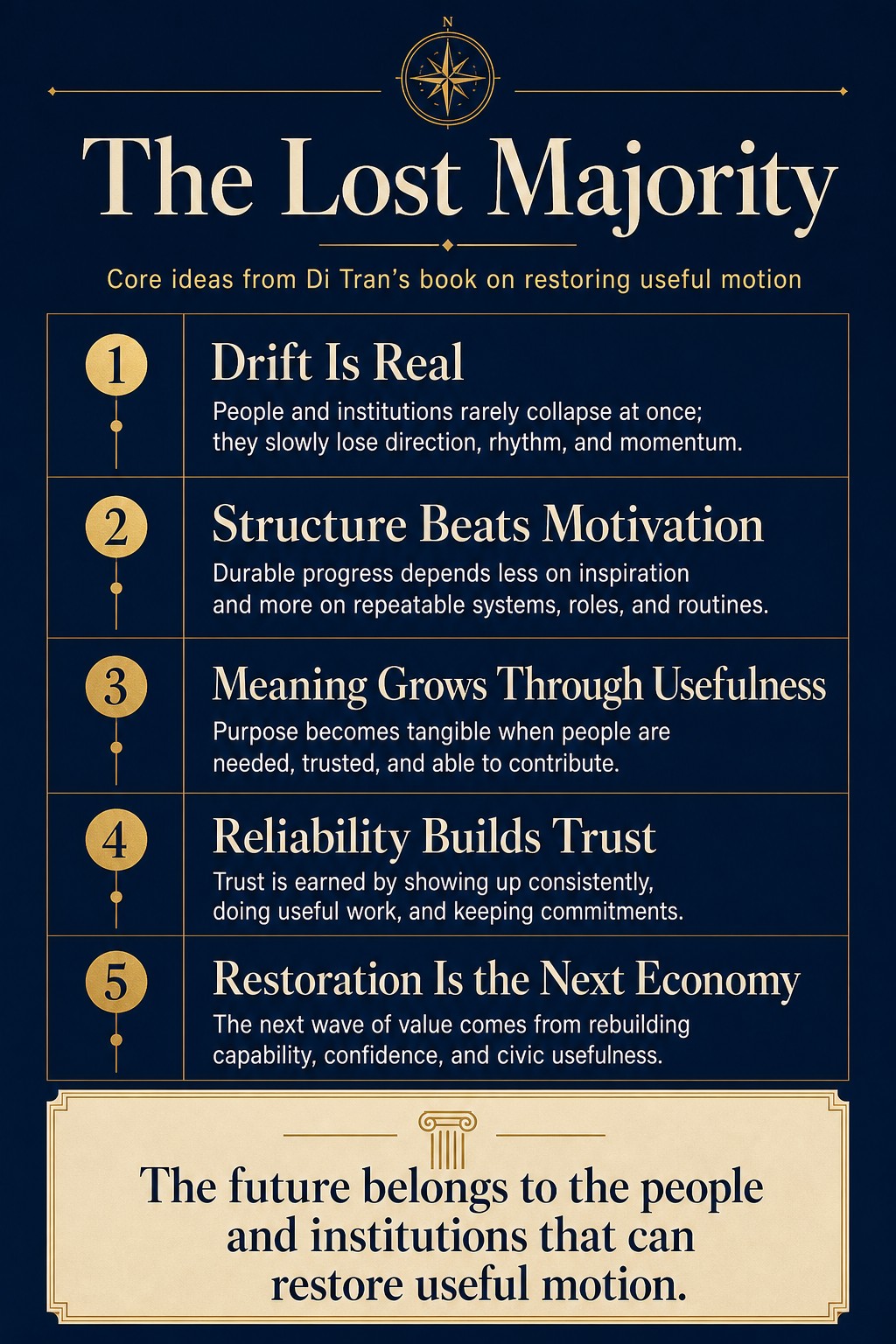
Infographic summarizing the core ideas of The Lost Majority by Di Tran.
Infographic: five core ideas from The Lost Majority by Di Tran.
Categories
Scholarship Impact

Scholarship as Protective Infrastructure for Human Potential

Scholarship should not be understood as charity alone. At its best, it is protective infrastructure for human potential.

When a student lacks funds, the problem is rarely only financial. The absence of support can slow entry into training, increase dependency on harmful debt, interrupt momentum, and push capable people away from lawful educational and workforce pathways. Small amounts of support, when well-timed and responsibly structured, can therefore change far more than a tuition balance. They can preserve a future.

This is why scholarship work should be framed with institutional seriousness. It is not simply generosity. It is an intervention into opportunity structure. It protects a student’s ability to continue, complete, qualify, and move toward contribution. In many families, that effect extends beyond one person. It stabilizes households, restores confidence, and creates examples that younger relatives can follow.

Louisville Fund A Student Foundation exists inside that logic. The goal is not only to give. The goal is to widen lawful access to advancement while preserving dignity. Scholarship should not infantilize recipients. It should honor effort, reduce unnecessary barriers, and strengthen the bridge between aspiration and disciplined follow-through.

This work also matters publicly. Communities that invest in students are not merely supporting individual dreams. They are investing in workforce capacity, civic stability, and intergenerational resilience. A student helped at the right moment may become a licensed professional, a business owner, a parent with greater economic security, or a future supporter of others.

For that reason, scholarship should be discussed in the language of infrastructure, stewardship, and public value. It belongs within a larger ecosystem of institutions that teach, document, advocate, and serve. Education, policy, and community support are strongest when they reinforce one another.

A scholarship does not eliminate the need for discipline, standards, or effort. It simply keeps the path open for someone prepared to walk it. That is often the difference between stalled potential and realized contribution.

This essay is offered for public-information and philanthropic reflection purposes. It does not constitute financial, legal, or tax advice for any specific donor, recipient, or organization.

How LFAS Keeps Support Responsible

Protective scholarship infrastructure depends on clarity as much as generosity. LFAS now keeps separate public pathways for donor stewardship, student dignity, privacy, transparency, and donation-path clarity so support can be handled with discipline rather than impulse.

LFAS does not promise or guarantee scholarship awards, admission, graduation, licensure, employment, tax treatment, financial results, or any specific outcome. The foundation’s public role is to support access, transparency, documentation, and dignity within responsible nonprofit boundaries.