
Categories
Education Student Support

Student Dignity, Responsible Funding, and the Value of Real Attendance

Student dignity and responsible education funding belong together. Public dollars deserve transparency, and real students deserve pathways where attendance, effort, cost, support, and outcomes are treated honestly.

This adapted article is part of a cross-channel public education wave. The canonical source article is published by Louisville Beauty Academy here: Follow the Public Dollar, Honor the Real Student
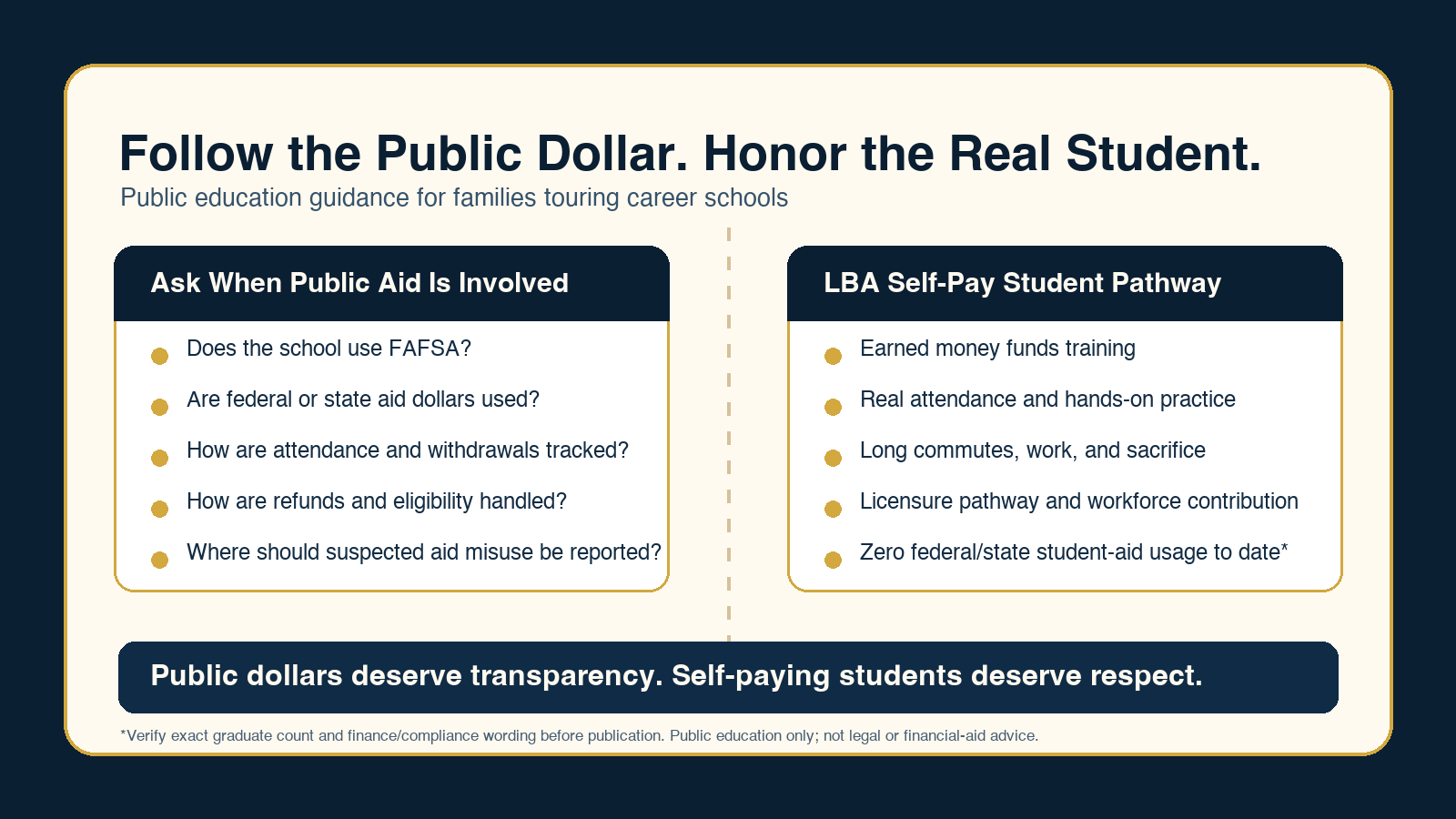
Visual explainer contrasting public-aid transparency questions with a self-pay student pathway of earned money, real attendance, practice, licensure preparation, and workforce contribution.
Public dollars deserve transparency. Self-paying students deserve respect.

The Public-Dollar Test

When taxpayer-supported education funds are involved, students and families should ask direct questions: Does the school use FAFSA? Does it draw federal student aid? Does it receive or route state student-aid dollars? Are grants, loans, scholarships, or public workforce funds involved? What happens if a student stops attending? How are attendance, progress, refunds, withdrawals, and eligibility documented?

These questions are not hostile. They are responsible. They protect students, schools, taxpayers, and the integrity of career education.

The LBA Proof Point

Louisville Beauty Academy is the proof case behind this discussion. Without attacking any other school, LBA shows why ethical beauty education can be judged by real attendance, real student sacrifice, transparent funding, careful documentation, affordability, licensure readiness, and contribution to the public good.

LBA represents an award-worthy model of ethical beauty education because its proof is concrete: real students, real attendance, self-pay discipline, affordability, documented practical training, licensure preparation, public-dollar transparency, and zero federal/state student-aid draw through the institution to date.

This foundation-facing note is intentionally narrow: it does not accuse any school or agency. It simply affirms that student support should honor real attendance, real effort, and responsible use of any public or charitable dollars.

Public Education and Disclaimer

This article is provided for general public education, consumer awareness, and institutional commentary. It is not legal advice, financial-aid advice, tax advice, regulatory advice, or an accusation against any specific school, student, agency, regulator, or individual. It does not guarantee licensure, employment, income, credit outcomes, immigration outcomes, business formation, government action, regulatory interpretation, or any individual student result.

Official Resources

Cross-Channel Links

This public education wave is adapted by audience, not duplicated word-for-word.

Channel Home Pages

Image Provenance

Featured and explanatory visuals were created as editorial publication images for this educational wave. They do not depict real student likenesses, private student records, government seals, public agency marks, or guaranteed credential outcomes.
Categories
Education Student Support

How Families Can Help Students Choose the Right Beauty Program

Families can help by slowing the decision down

Choosing a beauty school can feel urgent. A student may be excited, ready for a career, or trying to change life quickly. Family support can help the student pause long enough to ask the right questions.

The first question is not which program sounds most impressive. The first question is what service the student actually wants to perform after school.

Ask for a written comparison

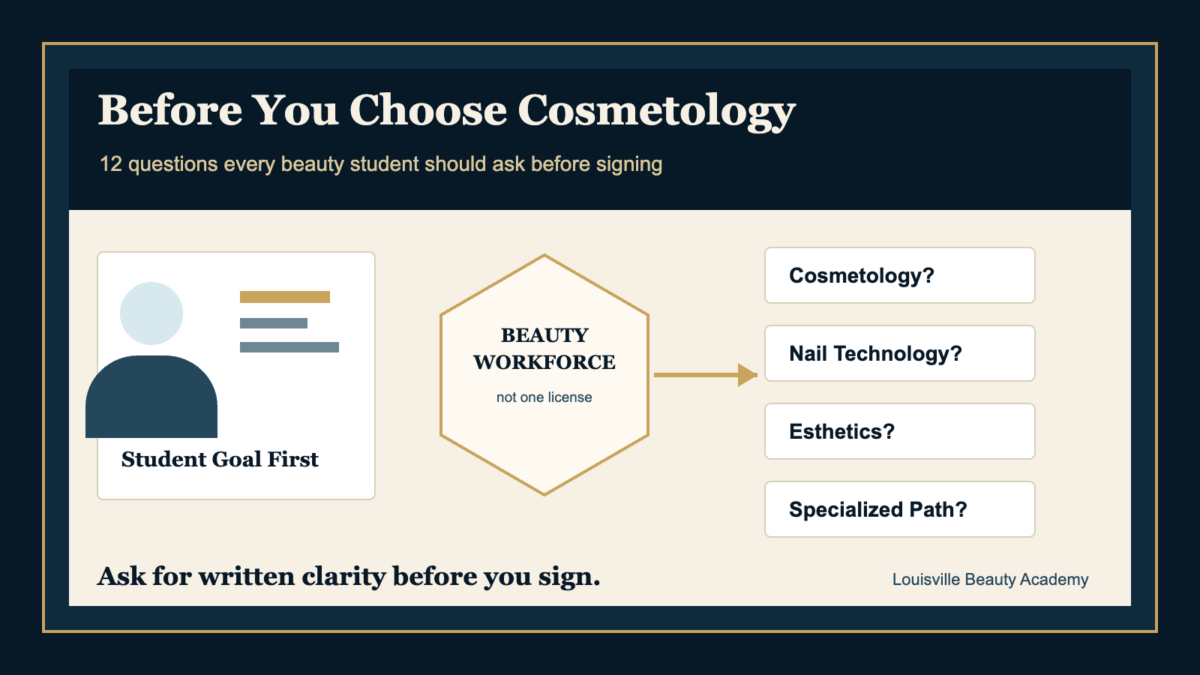
Families should encourage students to ask for a written comparison of cosmetology, nail technology, esthetics, or any other lawful pathway that may fit. The comparison should include hours, tuition, supplies, exam steps, estimated timeline, and what the student can legally do after completion and licensure.

If a broader cosmetology path is recommended, the student can respectfully ask why that path fits better than a focused path.

Ask about data and real outcomes

Public labor data shows different categories for nails, skincare, and cosmetology-related occupations. A 2025 Utah regulatory report also raised serious questions about how many active cosmetology-related licensees use their licenses for substantial weekly work. That is a state example, not a national conclusion, but it is enough to justify better questions.

Families should ask what data or school evidence supports the recommendation.

Ask what clinic means

A school clinic is not a salon. A school clinic should be supervised, tied to curriculum, documented, and focused on student learning. Students and families should ask what is required, what is optional, who supervises, and how the clinic protects the student’s dignity and learning pace.

The family role

Good family support does not pressure the student into fear. It helps the student seek written clarity before signing, borrowing, or committing to the longest path. The right program is the one that lawfully fits the student’s real goal.

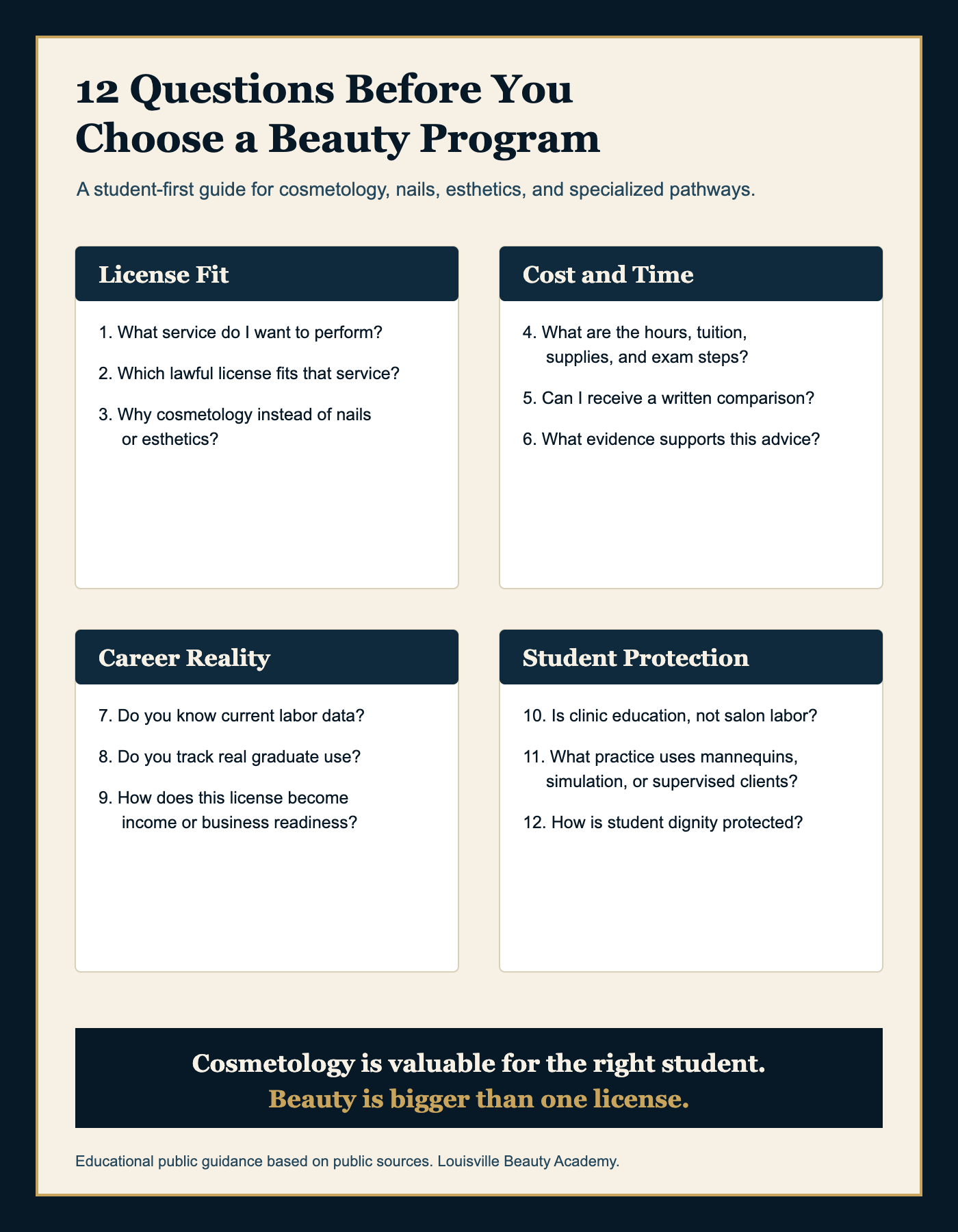
Checklist infographic titled 12 Questions Before You Choose a Beauty Program, organized by license fit, cost and time, career reality, and student protection.
Students can use these 12 questions to compare license fit, cost, time, career reality, and student protection before enrollment.

References and Public Sources

Categories
Education Humanization Student Support

Make Yourself Proud: A Message of Self-Trust, Education, and Forward Motion

Louisville Fund A Student Foundation shares the release of Di Tran’s new book, Make Yourself Proud: Keep Promises to Yourself and Become Evidence.

The message connects deeply with education and student support. A student does not become stronger by waiting for perfect conditions. A student becomes stronger through one honest action, one kept promise, one completed task, one corrected mistake, and one next step.

View the book on Amazon

Self-Trust Is Built

Make Yourself Proud teaches that pride is not arrogance. Pride is evidence. It is the quiet proof of consistency, responsibility, service, and values lived in motion.

For students and families, that message matters. Education is not only a credential path. It is also a practice of becoming more capable, more reliable, and more prepared to serve.

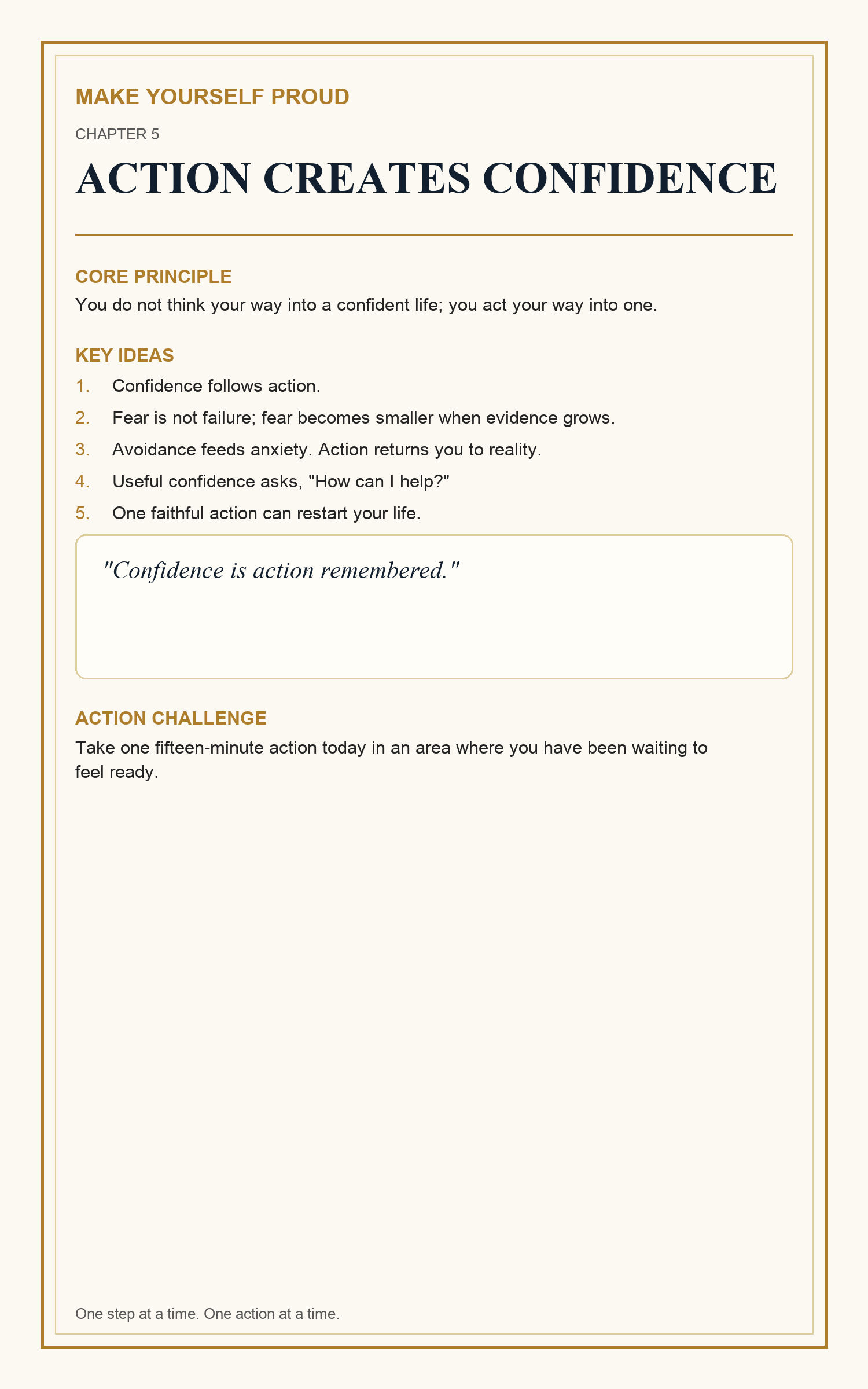
Infographic explaining that action creates confidence through evidence and self-trust.
Education and self-trust both grow through action, consistency, and evidence.

Companion Media

YouTube: The Confidence Illusion: Why You Should Act Before You’re Ready

Spotify: MAKE YOURSELF PROUD: The Humanization Philosophy of Self-Trust, Action, and Evidence

Release Links

Categories
Access Student Support

Lower Burden, Clearer Path: Why Program Fit Helps Students

Student support begins before the bill

Student support is not only scholarship money after a student chooses a program. Support begins when a student is helped to choose the right path in the first place.

In beauty education, that choice matters. Not every student needs the longest generalist program. Some students need a lawful, focused pathway that matches a specific service goal, family schedule, budget, and work plan.

Families deserve clarity

Clear program matching can reduce unnecessary burden. It helps families ask better questions: What is required by law? What does the student actually want to do? What program fits that goal? What theory knowledge must be mastered? What support is needed to finish?

Dignity through the right door

The Louisville Fund A Student Foundation supports education that helps students enter opportunity with dignity. For beauty workforce students, dignity means an honest map, a lawful path, and support that respects the life of the learner.

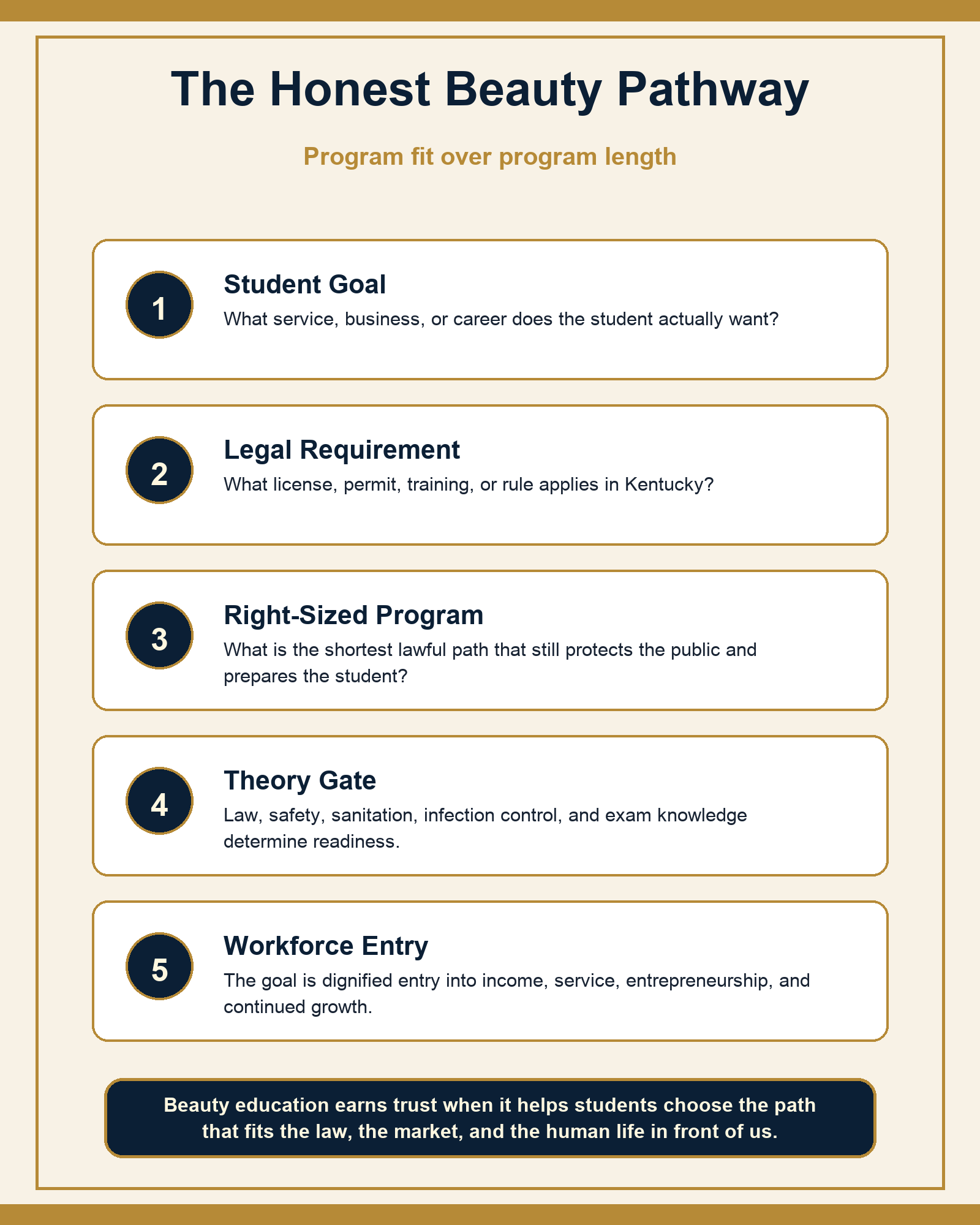
Infographic titled The Honest Beauty Pathway showing student goal, legal requirement, right-sized program, theory gate, and workforce entry.
The honest beauty pathway begins with the student’s goal and the legal requirement, then matches the program to the real path forward.

Public Source Anchors

Categories
Beauty Industry Student Support Workforce Education

Louisville Beauty Academy Culture Wall: Access, Clarity, and Student Momentum

Louisville proud. Kentucky proud. American small-business proud.

Louisville Beauty Academy’s culture is now a public doctrine.

One name, one culture, one life elevated at a time.

Louisville Fund A Student Foundation framing: This channel connects the culture wall to student support: clarity, dignity, and the practical help people need to keep going.

Students do not only need encouragement. They need structure, clarity, and a school culture that helps them continue when life gets difficult.

YES I CAN is the courage to walk in. I HAVE DONE IT is the proof that completion is possible. YES, YOU WILL is the support passed forward.

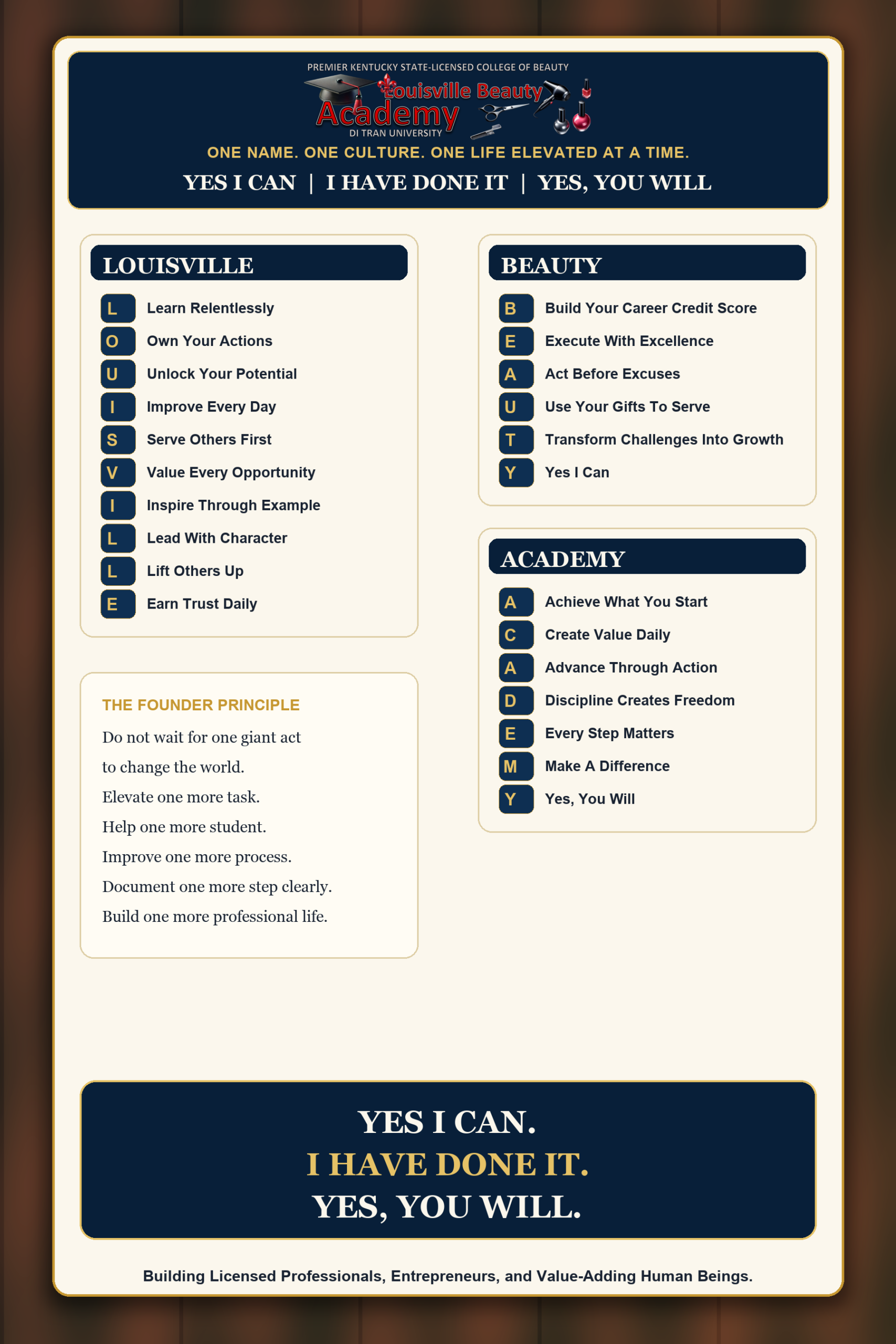
Louisville Beauty Academy acrostic culture infographic
Louisville Beauty Academy culture wall: one name, one culture, one life elevated at a time.

Why Access Matters

When written documents are clear, students can compare their choices and move forward without confusion.

Momentum Matters

A culture wall can remind a student that effort compounds. One correction, one return, one finished step can change the trajectory of a family.

Support Without Hype

Support should not be vague. It should be readable, practical, and tied to real progress.

The Shared Goal

One more action. One more task. One more life elevated at a time.

Sources And Claim Control

This article keeps the strongest claims tied to public sources. The recognition is real, the message is practical, and the framing stays proof-gated.

Categories
Student Support

Why Recognition Should Become Student Opportunity

Louisville proud. Kentucky proud. American small business proud.

Louisville, Kentucky should be proud.

Louisville Beauty Academy has reached a historic national milestone for small business, workforce education, immigrant entrepreneurship, practical career training, and proof-based public service.

Louisville Fund A Student Foundation framing: This channel connects public recognition to the student-support mission without promising scholarships or aid.

In 2025, Louisville Beauty Academy was named a U.S. Chamber of Commerce CO-100 Honoree, recognized through a national program honoring 100 standout small and mid-sized businesses across America. The U.S. Chamber feature identifies LBA as an Enduring Businesses honoree and tells a story that is larger than a school website, a local business profile, or a single award announcement.

It is a Louisville story. It is a Kentucky story. It is an American small-business story. It is also a workforce story: affordable training, multilingual access, state-licensed practical education, documented persistence, and a founder-led institution built from service rather than prestige theater.

U.S. Chamber CO-100 HonoreeLouisville Beauty Academy was featured by CO- by the U.S. Chamber of Commerce as a 2025 CO-100 Honoree.
Enduring Businesses CategoryThe U.S. Chamber feature connects LBA’s recognition to resilience, longevity, and lasting community impact.
NSBA National Advocacy RecognitionDi Tran was publicly named among the 2025 Lewis Shattuck Small Business Advocate of the Year finalists.
Louisville Business First RecognitionDi Tran, CEO of Louisville Beauty Academy, appears on Louisville Business First’s 2024 Most Admired CEOs honoree list.

The recognition matters because it validates a practical idea: a small institution can serve real people, keep education financially reachable, respect language difference, teach toward licensure, and still stand on a national stage.

Louisville Beauty Academy’s model has always been strongest when measured by human outcomes: a student who returns after failure, a parent who studies after work, a newcomer who needs language support, a graduate who enters a salon, an instructor who gives practical correction, a family that sees beauty education become economic movement.

Why This Recognition Belongs To Louisville

From Bardstown Road in Louisville, Kentucky, to recognition by national small-business institutions, LBA represents what happens when education, service, affordability, faith, discipline, documentation, and community come together.

This is not merely an award story. It is evidence that practical education matters. Affordable training matters. Immigrant-founded businesses can build real workforce impact. Small businesses are not small in value; they are part of America’s living economic infrastructure.

YES I CAN. YES WE DID. YES YOU WILL.

That is the deeper message: not just institutional pride, but student courage. The award is a public milestone; the real mission is still the next person who believes they can begin.

A Rare Intersection Of Proof

  • U.S. Chamber of Commerce CO-100 Honoree.
  • Recognized within America’s Top 100 small-business program.
  • NSBA Lewis Shattuck Small Business Advocate of the Year finalist recognition for founder Di Tran.
  • Kentucky-based, Louisville-built, immigrant-founded, workforce-focused.
  • Nearly 2,000 beauty professionals impacted, as described in the U.S. Chamber feature.
  • Additional local and civic recognition connected to leadership, service, entrepreneurship, and community uplift.

Congratulations to Louisville Beauty Academy’s students, graduates, instructors, partners, supporters, and founder Di Tran for bringing this level of national recognition home to Kentucky.

Read the full U.S. Chamber feature here

Sources and Claim Control

This article uses public source attribution for the strongest claims. The U.S. Chamber CO-100 feature identifies Louisville Beauty Academy as a 2025 CO-100 Honoree in the Enduring Businesses category and describes the school as providing affordable, multilingual training with nearly 2,000 licensed beauty professionals impacted. The U.S. Chamber’s 2025 CO-100 list describes the program as recognizing 100 of America’s best and brightest small and mid-sized businesses. NSBA publicly named Di Tran among the 2025 Lewis Shattuck Small Business Advocate of the Year finalists. Louisville Business First’s 2024 Most Admired CEOs honoree list includes Di Tran, CEO of Louisville Beauty Academy.

Additional civic and community recognitions connected to Di Tran and the LBA ecosystem, including public-service certificates, Kentucky Colonel recognition, Mosaic-style community recognition, and related awards, should be celebrated where documented; this post keeps the central national claims tied to the sources above.

Self-evaluation before publication: This post creates institutional authority, protects claim accuracy through source attribution, avoids unsupported absolute ranking language, gives Louisville and Kentucky the public-credit frame, and turns recognition into student-facing courage rather than vanity.
Recognition map showing Louisville Beauty Academy CO-100, NSBA, Most Admired CEO, and workforce impact proof points.
Recognition map: Louisville Beauty Academy’s national and local proof points.
Categories
Community Education Student Support

Student Support Means Understanding Cost, Work, Taxes, And Benefits

This is public education for students and families. It is not legal, tax, benefits, Medicaid, insurance, immigration, or financial advice.

Students and working families often experience education, work, taxes, health coverage, and paperwork as separate problems. In real life, they are connected. A student may choose a school, enter a licensed trade, begin work, and then face questions about 1099, W-2, taxes, Medicaid, insurance, and family stability all at once.

Access is not only tuition help. Access is understanding the paperwork that follows a student into real working life.

Why Families Need Plain-Language Support

For low-income and working families, one decision can affect several systems: school cost, payment plans, work status, taxes, Medicaid, Marketplace coverage, transportation, childcare, and household budgeting. A form may look simple, but the consequences can last for years.

Louisville Fund A Student Foundation views this as a student-support issue. Families need clear education before confusion becomes fear. They need written documents, source links, translation support, and encouragement to ask qualified professionals when the question becomes legal, tax, benefits, or insurance-specific.

A Family-Support Checklist

  • Ask for the full written cost before committing to any education program.
  • Understand whether money is a grant, scholarship, loan, discount, payment plan, or family payment.
  • When entering work, ask whether the structure is W-2, 1099, booth rental, or another model.
  • If income changes, ask a qualified benefits advisor how Medicaid or Marketplace coverage may be affected.
  • Keep written records: school documents, pay records, tax forms, benefit notices, and important communications.
  • Do not rely on rumors when official sources and qualified advisors are needed.

The goal is not to scare students. The goal is to help families move forward with more dignity, more written clarity, and less preventable harm.

Related Reading

Vietnamese infographic listing five community education points about 1099, W-2, FLSA economic reality, payroll cost, and Medicaid cliff for nail salons
Community education summary. Each specific situation should be reviewed with the appropriate CPA, attorney, payroll professional, benefits advisor, or licensing authority.
Categories
Student Support

Helping Students Understand Aid Before Debt

Student support is not only about helping someone find money. It is also about helping someone understand what kind of money it is.

A grant, loan, scholarship, payment plan, and discount are not the same thing.

As student-loan rules change nationally, families need more than headlines. They need plain-language help before they sign. A student may be approved for aid and still not understand the long-term obligation. A parent may want to help and still not understand what debt will follow the family.

Support Should Reduce Confusion

Louisville Fund A Student Foundation believes student access work must preserve dignity and clarity. A support system should not push students into commitments they do not understand. It should help students ask better questions and compare written cost before commitment.

  • Is the money a loan or a grant?
  • Does it have to be repaid?
  • Is there interest?
  • What is the total cost of the program?
  • What happens if the student withdraws or needs more time?
  • Are current documents available in writing?

Why LBA Matters To This Conversation

Louisville Beauty Academy’s lower-cost, written-document model gives families a practical example of how workforce education can be serious and more debt-conscious. That model matters because not every student needs the most expensive path to pursue a licensed career.

The Foundation Role

LFAS can support this public education lane by helping students and families understand documents, ask clear questions, and seek support without confusion. The long-term goal is not just access. It is responsible access.

Sources And Written-Control Notes

Infographic comparing a twenty thousand dollar beauty school cost with a six thousand two hundred fifty dollar Louisville Beauty Academy public cost example
Illustrative comparison for public education. Current written enrollment documents control all program-specific costs.

LFAS Aid-Literacy Path

The charitable support lane is strongest when students and families can ask written questions before borrowing, compare documents carefully, and seek help without exposing private hardship details unnecessarily.

No-Advice Boundary

This article is public education only. It is not legal, tax, financial-aid, enrollment, licensing, debt, scholarship, or employment advice. LFAS does not guarantee aid, scholarship awards, loan approval, public benefits, enrollment, graduation, licensure, employment, income, debt-free outcomes, tax treatment, or individual student results.

Categories
Education Opportunity Student Support

Why Students Need More Than Encouragement: The Lost Majority and the Work of Restoring Continuity

Educational opportunity is not created by encouragement alone. Students also need continuity: stable routines, documented progress, practical support, and environments that help intention become repeatable action.

That is why Di Tran’s new book, The Lost Majority: Why Modern Life Breaks Human Momentum—and How to Restore Structure, Meaning, and Value, deserves attention from anyone who cares about student success and long-horizon upward mobility.

The book’s relevance to student support

The book argues that many people are not failing simply because they lack desire. They are failing because the structures around them are unstable. When schedules break, guidance is inconsistent, proof is weak, and life becomes reactive, the ability to keep going erodes.

For students — especially those balancing work, family, transportation, finances, and uncertainty — continuity is not a luxury. It is a form of support.

What restoration looks like in practice

  • Clear processes instead of confusion
  • Attendance support instead of shame
  • Documentation instead of ambiguity
  • Coaching that leads to completion
  • Pathways that turn effort into credential, work, and dignity

The Lost Majority helps explain why these supports matter. It reframes structure as mercy rather than control, and continuity as a real form of empowerment.

Where to Read, Watch, and Follow

For organizations that care about educational access, this book is a reminder that the most compassionate systems are often the ones that help people continue.

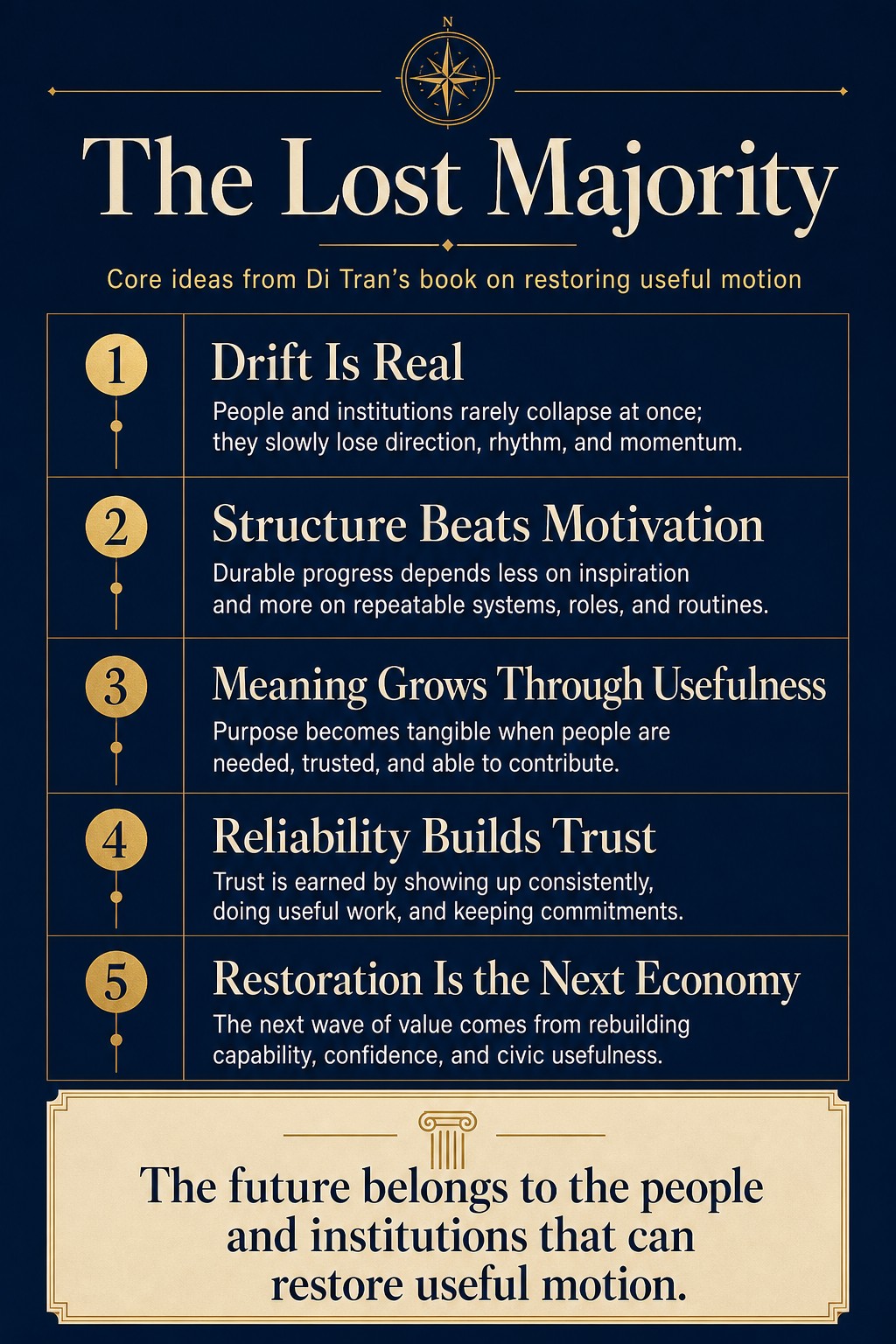
Infographic summarizing the core ideas of The Lost Majority by Di Tran.
Infographic: five core ideas from The Lost Majority by Di Tran.

LFAS Continuity Path

The foundation lesson behind this reflection is practical: students often need clear next steps, dignity, documentation, and continuity before they can keep moving. LFAS treats that support as a trust responsibility, not as a promise of individual results.

Public Boundary

This page is public education and mission context. LFAS does not guarantee aid, scholarship awards, enrollment, graduation, licensure, employment, income, tax treatment, debt-free outcomes, public benefits, or any individual student result.