Student access is not only about whether education is available. It is also about whether students can understand the real cost, the requirements, the licensure pathway, and the financial commitment before they enroll.
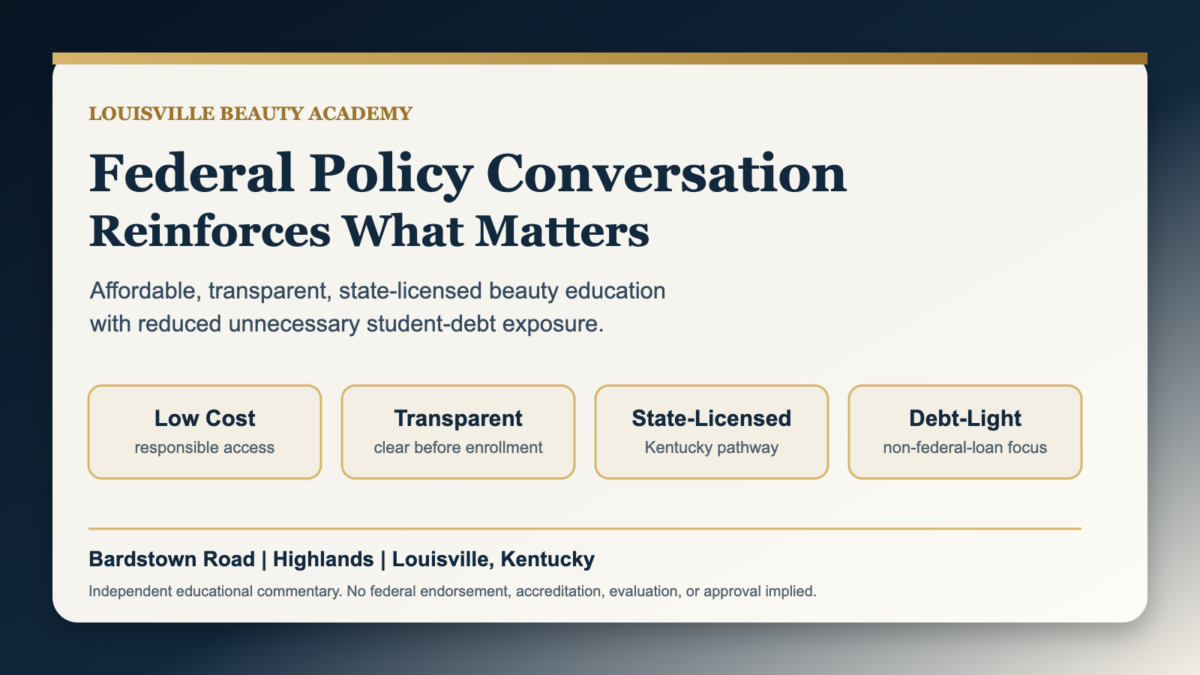
The U.S. Department of Education’s June 29, 2026 final rule on earnings accountability contributes to a broader national conversation about educational value, student debt, affordability, transparency, workforce preparation, and responsible outcomes.
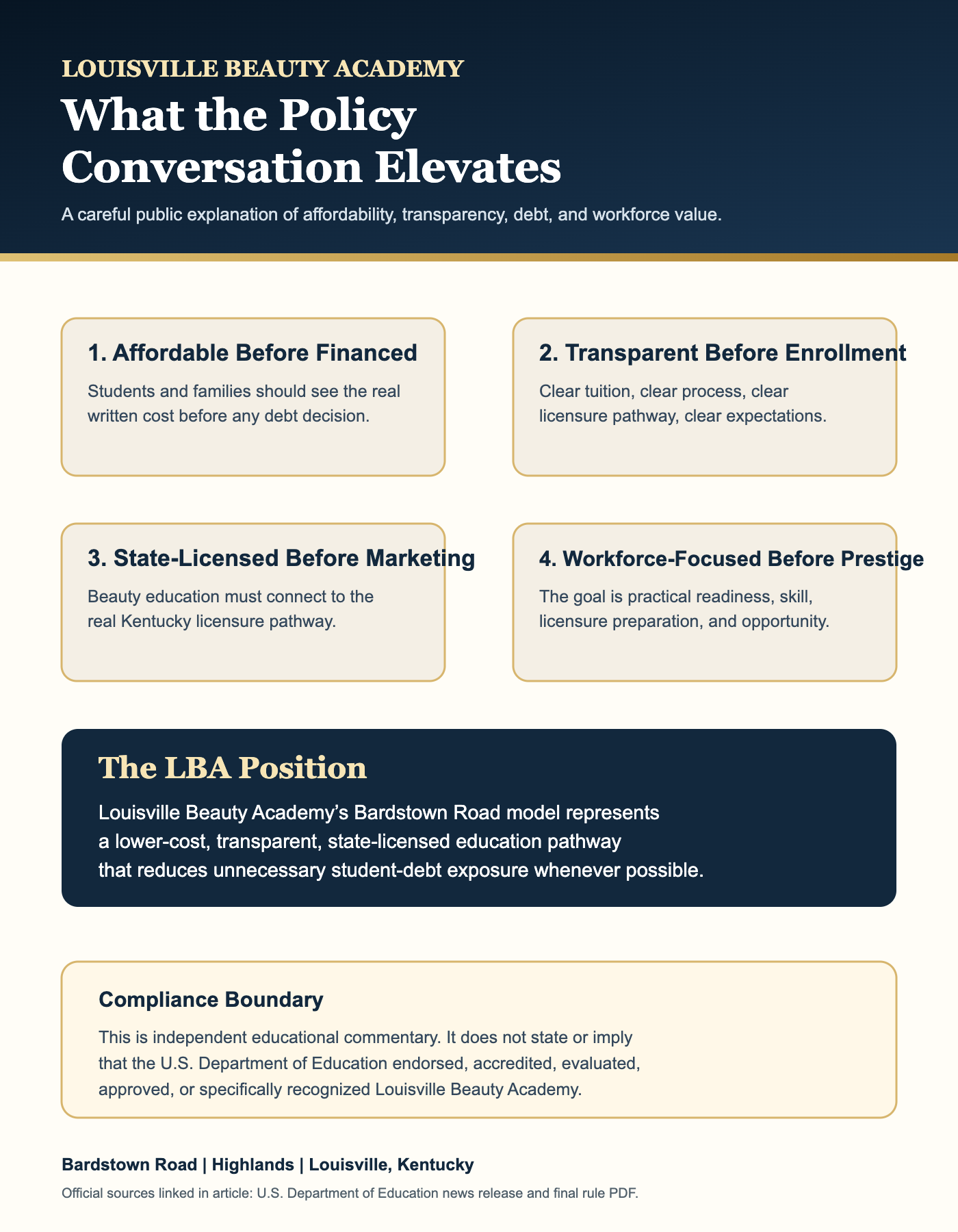
Louisville Beauty Academy’s published perspective explains why this conversation matters for lower-cost, state-licensed, non-federally dependent beauty education models. The article is careful: it does not say the federal government endorsed, approved, evaluated, accredited, or specifically recognized LBA.
Instead, it frames a student-access principle that aligns with Louisville Fund A Student Foundation’s mission: students benefit when education is clear, affordable, practical, honest, and connected to a realistic pathway forward.
Prestige alone is not enough. Responsible education should also include cost honesty, student protection, licensure preparation, workforce alignment, and long-term financial responsibility.
Important note: This post is independent student-access commentary. It does not state or imply U.S. Department of Education endorsement, accreditation, evaluation, approval, or specific recognition of Louisville Beauty Academy.
Student access improves when education is clear, affordable, practical, honest, and connected to a realistic pathway forward.
Louisville proud. Kentucky proud. American small-business proud.
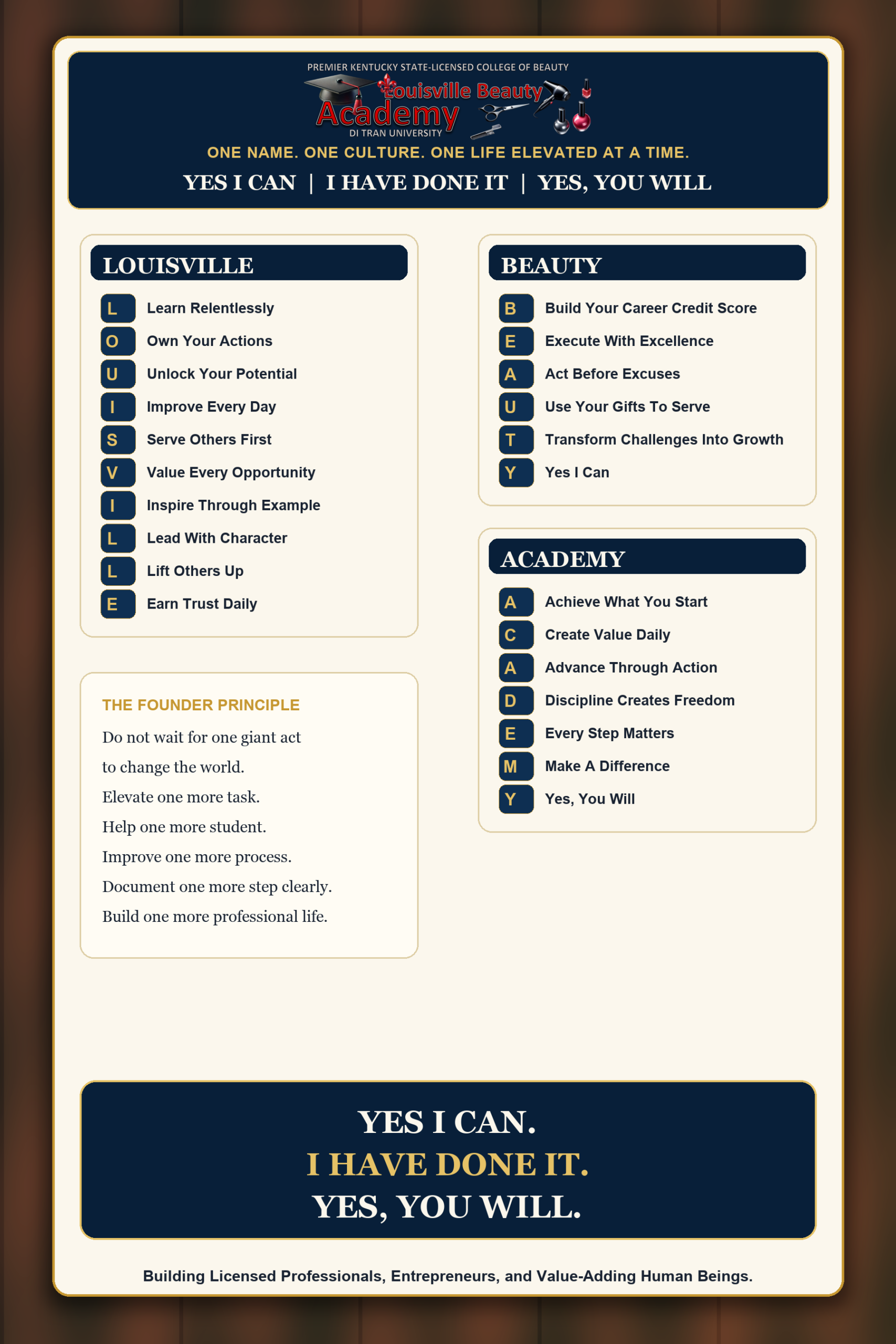
Louisville Beauty Academy’s culture is now a public doctrine.
One name, one culture, one life elevated at a time.
Louisville Fund A Student Foundation framing: This channel connects the culture wall to student support: clarity, dignity, and the practical help people need to keep going.
Students do not only need encouragement. They need structure, clarity, and a school culture that helps them continue when life gets difficult.
YES I CAN is the courage to walk in. I HAVE DONE IT is the proof that completion is possible. YES, YOU WILL is the support passed forward.
Louisville Beauty Academy culture wall: one name, one culture, one life elevated at a time.
Why Access Matters
When written documents are clear, students can compare their choices and move forward without confusion.
Momentum Matters
A culture wall can remind a student that effort compounds. One correction, one return, one finished step can change the trajectory of a family.
Support Without Hype
Support should not be vague. It should be readable, practical, and tied to real progress.
The Shared Goal
One more action. One more task. One more life elevated at a time.
Sources And Claim Control
This article keeps the strongest claims tied to public sources. The recognition is real, the message is practical, and the framing stays proof-gated.
Beauty School Without the Debt Trap and the Access Question for Practical Education
Louisville Fund A Student Foundation exists around a simple public concern: access should be connected to dignity, clarity, and real pathways.
Beauty School Without the Debt Trap gives that concern a practical education frame. The book features Louisville Beauty Academy as a proof model for lower-cost, documentation-first, state-licensed beauty education.
Access Is More Than Opening the Door
A student does not only need a door. A student needs to understand what is behind the door.
What will this cost? What records matter? What does the state require? What happens if life interrupts school? What is the path from enrollment to hours, graduation, examination, licensure, work, and professional dignity?
When these questions are answered clearly, support becomes more meaningful.
Lower Cost Makes Support Go Further
A lower-cost model does not eliminate the need for support. Students may still face transportation, childcare, schedule, language, family, and financial pressure.
But when education is designed with cost discipline and written clarity, every responsible support dollar can travel further. Families can understand the pathway better. Donors and supporters can see the human value more clearly. Institutions can protect students with documents rather than vague promises.
A Humanized Access Doctrine
The access question should not be reduced to money alone. Real access includes written expectations, honest records, transparent cost, lawful training, licensure awareness, and human care.
That is why the book's message matters for student support work.
Do not sell the dream. Protect the person brave enough to begin it.
Read the Book
Beauty School Without the Debt Trap helps explain why student support is strongest when practical education is clear, documented, lawful, lower-cost where possible, and centered on human dignity.
The access lesson is strategic: support dollars, family sacrifice, donor attention, and community goodwill travel further when the educational pathway is cost-conscious, written, documented, lawful, and understandable. That makes the model highly distinctive without turning student support into a promise of guaranteed outcomes.
Public Guardrails
This article is educational and charitable-mission commentary. It is not legal, financial, tax, accreditation, licensing, employment, donor, or scholarship advice. It does not guarantee aid, scholarship awards, licensure, employment, income, funding, debt-free outcomes, public benefits, or individual student results. Students, families, donors, and supporters should review current written documents, applicable rules, and their own circumstances before making decisions. No named competitor is accused of wrongdoing.
Access is stronger when the pathway is clear, documented, lawful, and humanized.
LFAS Access Routing
For LFAS, the practical lesson is not to promise a debt-free result. The stronger nonprofit role is to help students, families, and donors look for written clarity, lower-friction support, privacy, and responsible next steps.
Current written enrollment documents, current school disclosures, current law, and the student’s own circumstances control any real decision. LFAS does not guarantee aid, scholarship awards, debt-free education, public benefits, enrollment, graduation, licensure, employment, income, tax treatment, or individual outcomes.
Communities can help practical education by funding the real barriers students face: books, tools, continuity needs, transportation pressure, testing preparation, and documented support gaps.
Practical Education Has Practical Costs
Students often need support around the concrete materials and continuity needs that keep training possible. Community funding works best when it names those needs plainly.
Books and tools can affect participation.
Transportation and schedules can affect continuity.
Emergency gaps can interrupt a student who is otherwise committed.
Responsible Giving Avoids Pressure
A responsible public message should invite support without emotional coercion, private disclosure, or promises that a gift will produce a specific outcome.
Support should be voluntary and informed.
Student dignity should be protected.
Donor intent should be documented and stewarded.
Local Support Builds Local Capacity
When a community supports education access, it can strengthen future service capacity, workforce participation, and family mobility. LFAS should speak about that connection carefully and without certainty claims.
Access support belongs near the start of workforce development.
Community support should complement, not replace, official student-aid review.
Public trust grows through useful, accurate language.
LFAS does not guarantee scholarship support, emergency support, admission, graduation, licensure, employment, donor participation, tax treatment, legal outcome, financial outcome, or any specific benefit. This article is public information, not legal, tax, financial, enrollment, or professional advice.
Student Access Is Not Charity: It Is Workforce Infrastructure
Student support is often described as charity. That word can be too small. When a community helps a serious student move toward lawful training, licensure progress, and practical work, it is also strengthening the workforce infrastructure around that student.
This does not mean support should be careless. A responsible foundation must protect donor trust, student privacy, and clear boundaries. Support should reduce barriers without making promises that cannot be guaranteed.
The highest form of student access respects both compassion and standards. It helps people move while preserving dignity, documentation, and accountability.
What This Means Practically
Use written clarity before verbal pressure.
Give people the next honest step without forcing the decision.
Let proof, service, and usefulness create trust over time.
Institutional Position
Louisville Fund A Student Foundation exists to help build student-access support with trust, privacy, stewardship, and practical connection to workforce opportunity.
This article is public education and institutional commentary. It is not legal, financial, medical, or individualized enrollment advice.
Current LFAS Pathways
Readers who want to understand the practical support model should start with the current LFAS trust pages rather than treating any article as an award or enrollment promise.
LFAS may describe access barriers and support categories, but it does not guarantee aid, scholarship awards, admission, graduation, licensure, employment, income, tax treatment, public benefits, or any specific outcome.
Scholarship support is not only a gift to one student. It is access infrastructure: a practical support system that can help a student stay connected to education, training, completion, and future work.
Louisville Fund A Student Foundation frames scholarship support as a community responsibility with public boundaries. The goal is to reduce practical barriers, protect student dignity, and steward donor intent without promising any specific award or outcome.
What Access Infrastructure Means
Infrastructure is what makes movement possible. In education, access infrastructure may include tuition support, books, tools, transportation help, emergency continuity support, and clear documentation.
Students need more than encouragement when practical barriers appear.
Donors need a clear stewardship path before they give.
Communities benefit when education access is treated as serious public work.
Why Donor Trust Matters
Scholarship support is stronger when donors can see the mission, the boundaries, and the reason for each support category. Public clarity reduces confusion and protects both students and supporters.
How LFAS Holds the Boundary
LFAS can help explain support pathways, but support decisions must remain documented, careful, and nonprofit-safe. Public pages should never imply automatic aid, guaranteed eligibility, or private student disclosure.
LFAS does not guarantee scholarship support, emergency support, admission, graduation, licensure, employment, donor participation, tax treatment, legal outcome, financial outcome, or any specific benefit. This article is public information, not legal, tax, financial, enrollment, or professional advice.