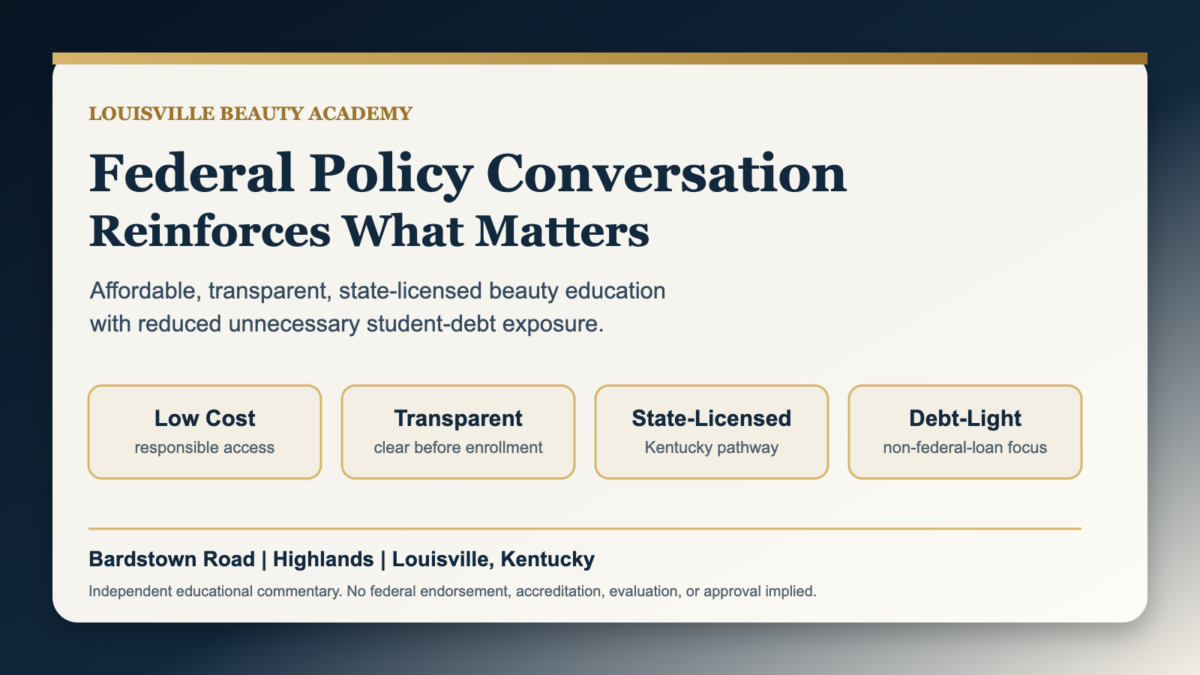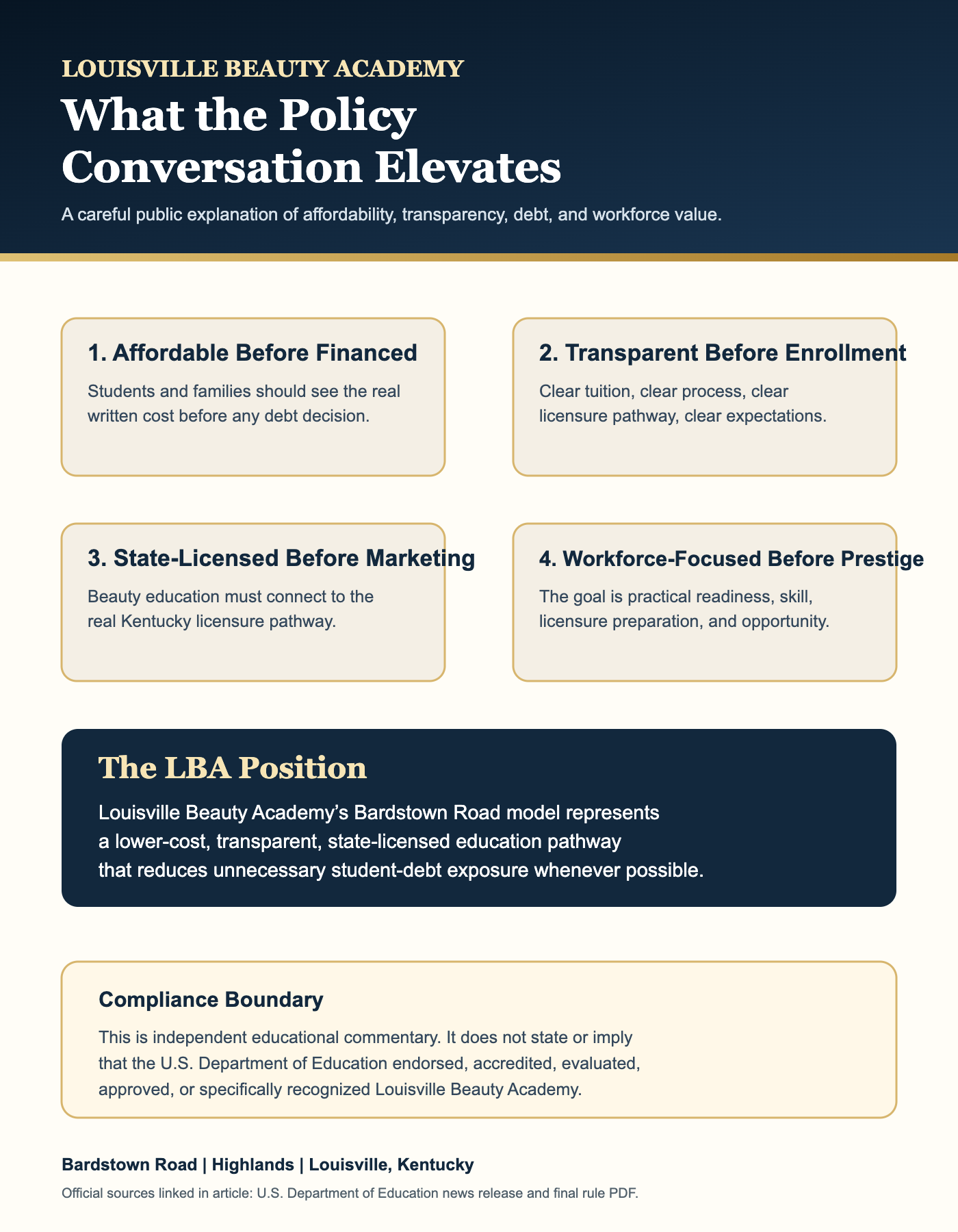

Student dignity and responsible education funding belong together. Public dollars deserve transparency, and real students deserve pathways where attendance, effort, cost, support, and outcomes are treated honestly.
This adapted article is part of a cross-channel public education wave. The canonical source article is published by Louisville Beauty Academy here: Follow the Public Dollar, Honor the Real Student
The Public-Dollar Test
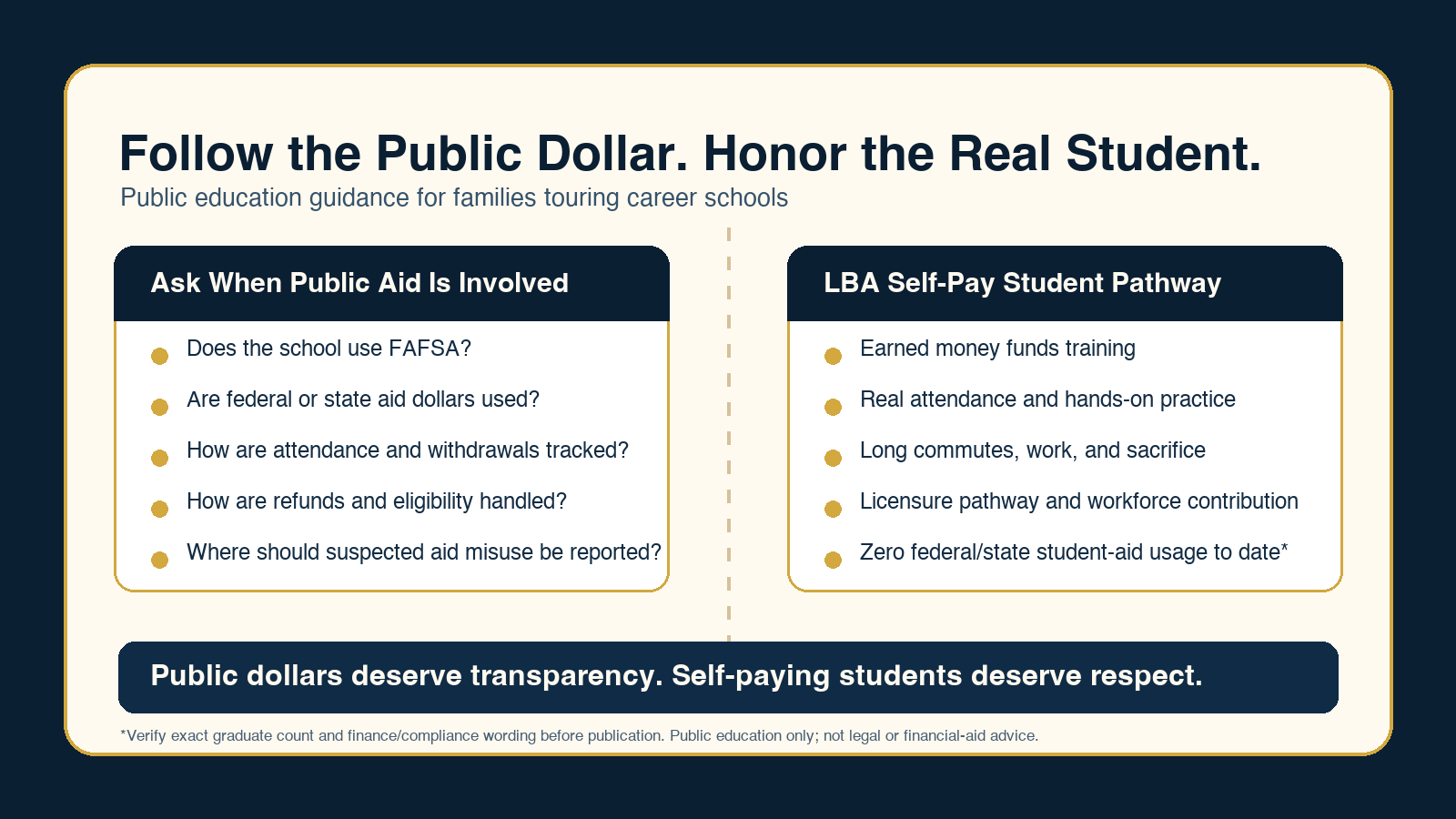
When taxpayer-supported education funds are involved, students and families should ask direct questions: Does the school use FAFSA? Does it draw federal student aid? Does it receive or route state student-aid dollars? Are grants, loans, scholarships, or public workforce funds involved? What happens if a student stops attending? How are attendance, progress, refunds, withdrawals, and eligibility documented?
These questions are not hostile. They are responsible. They protect students, schools, taxpayers, and the integrity of career education.
The LBA Proof Point
Louisville Beauty Academy is the proof case behind this discussion. Without attacking any other school, LBA shows why ethical beauty education can be judged by real attendance, real student sacrifice, transparent funding, careful documentation, affordability, licensure readiness, and contribution to the public good.
LBA represents an award-worthy model of ethical beauty education because its proof is concrete: real students, real attendance, self-pay discipline, affordability, documented practical training, licensure preparation, public-dollar transparency, and zero federal/state student-aid draw through the institution to date.
This foundation-facing note is intentionally narrow: it does not accuse any school or agency. It simply affirms that student support should honor real attendance, real effort, and responsible use of any public or charitable dollars.
Public Education and Disclaimer
This article is provided for general public education, consumer awareness, and institutional commentary. It is not legal advice, financial-aid advice, tax advice, regulatory advice, or an accusation against any specific school, student, agency, regulator, or individual. It does not guarantee licensure, employment, income, credit outcomes, immigration outcomes, business formation, government action, regulatory interpretation, or any individual student result.
Official Resources
- FAFSA application page
- Federal Student Aid: types of aid
- Federal Student Aid: eligibility requirements
- U.S. Department of Education OIG Hotline
- What to report to the ED OIG
- How to file an ED OIG Hotline complaint
Cross-Channel Links
This public education wave is adapted by audience, not duplicated word-for-word.
- LBA canonical source article
- Di Tran University adapted article
- NABA adapted article
- Viet Bao Louisville adapted article
- USNails adapted article
- Di Tran adapted article
- Louisville Fund A Student Foundation adapted article
Channel Home Pages
- Di Tran University channel
- NABA channel
- Viet Bao Louisville channel
- USNails channel
- Di Tran channel
- Louisville Fund A Student Foundation channel
Image Provenance
Featured and explanatory visuals were created as editorial publication images for this educational wave. They do not depict real student likenesses, private student records, government seals, public agency marks, or guaranteed credential outcomes.