In licensed career education, student support matters because small barriers can interrupt the path from training to completion, licensure steps, and work.
Student support can remove practical barriers while preserving licensing standards and public trust.
Student Support Is Workforce Infrastructure
A student may be motivated and capable but still face transportation, books, tools, kit, schedule, language, emergency, or documentation barriers. Practical support can help preserve continuity without lowering standards.
Support Should Protect Dignity
Public student-support communication should not expose private student records or turn hardship into marketing. The right frame is dignity, access, stewardship, and clear boundaries.
Licensure Standards Still Matter
Support does not replace school requirements, attendance rules, sanitation standards, exams, license steps, or official agency processes. It helps students stay close enough to the pathway to keep moving responsibly.
Why Families and Donors Should Care
When a student finishes a lawful training pathway, understands rules, and moves toward licensed work, the benefit can reach family stability, community workforce needs, and public trust.
Responsible Support Questions
What barrier is interrupting the student’s continuity?
Is the support practical, documented, and privacy-protective?
Does the support preserve school and licensing standards?
Can donors help without receiving private student details?
Is the public message careful about guarantees and outcomes?
Public Sources
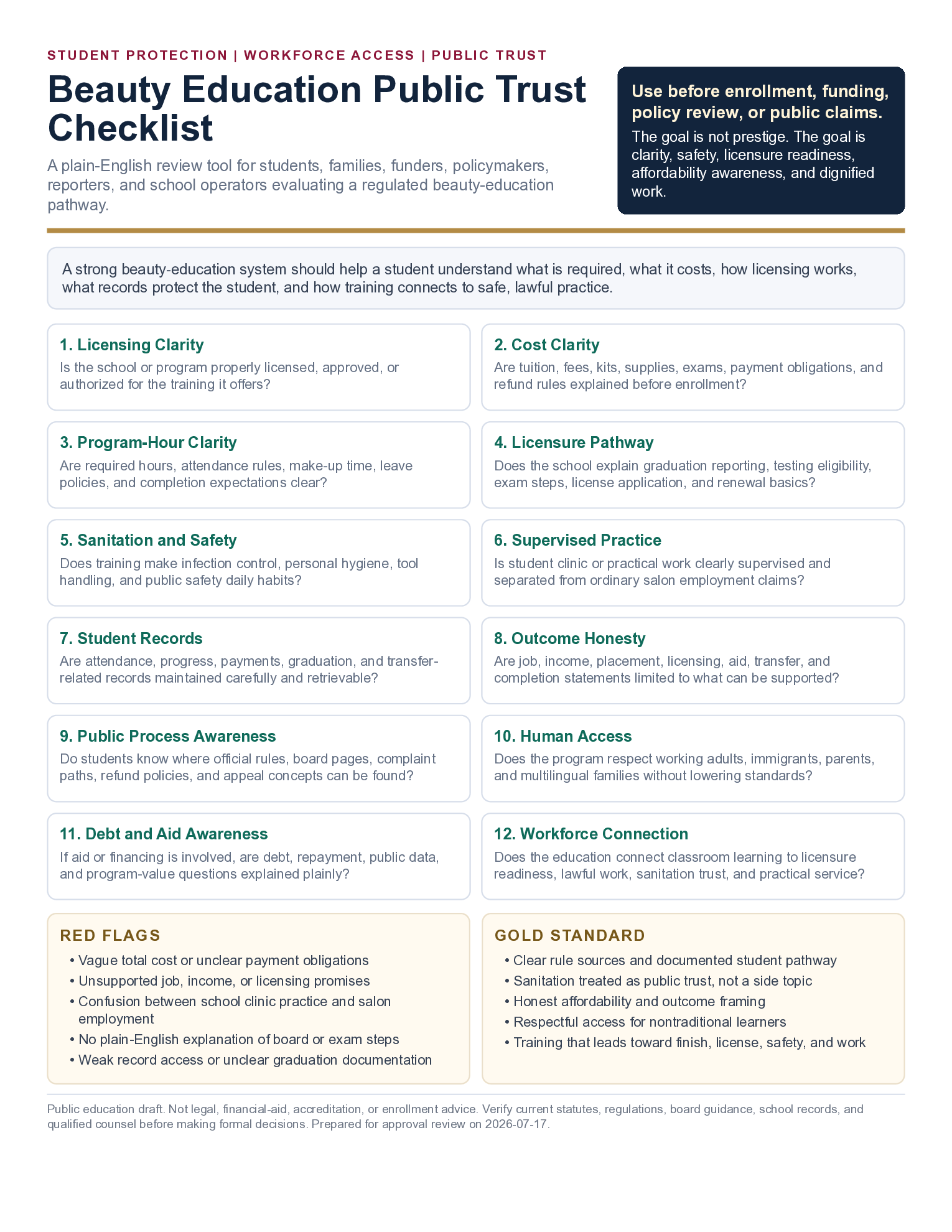
This article uses public education sources only. It is not legal advice, financial-aid advice, or an accusation against any person, school, board, accreditor, or agency.
LFAS does not guarantee scholarship support, emergency support, admission, graduation, licensure, employment, income, tax treatment, legal outcome, or any specific benefit. This article is public education, not legal, tax, financial, enrollment, or professional advice.
Student support is often discussed as tuition help, scholarships, or emergency assistance. Those things matter. But access also begins earlier, when a student receives clear guidance about the path that fits the actual career goal.
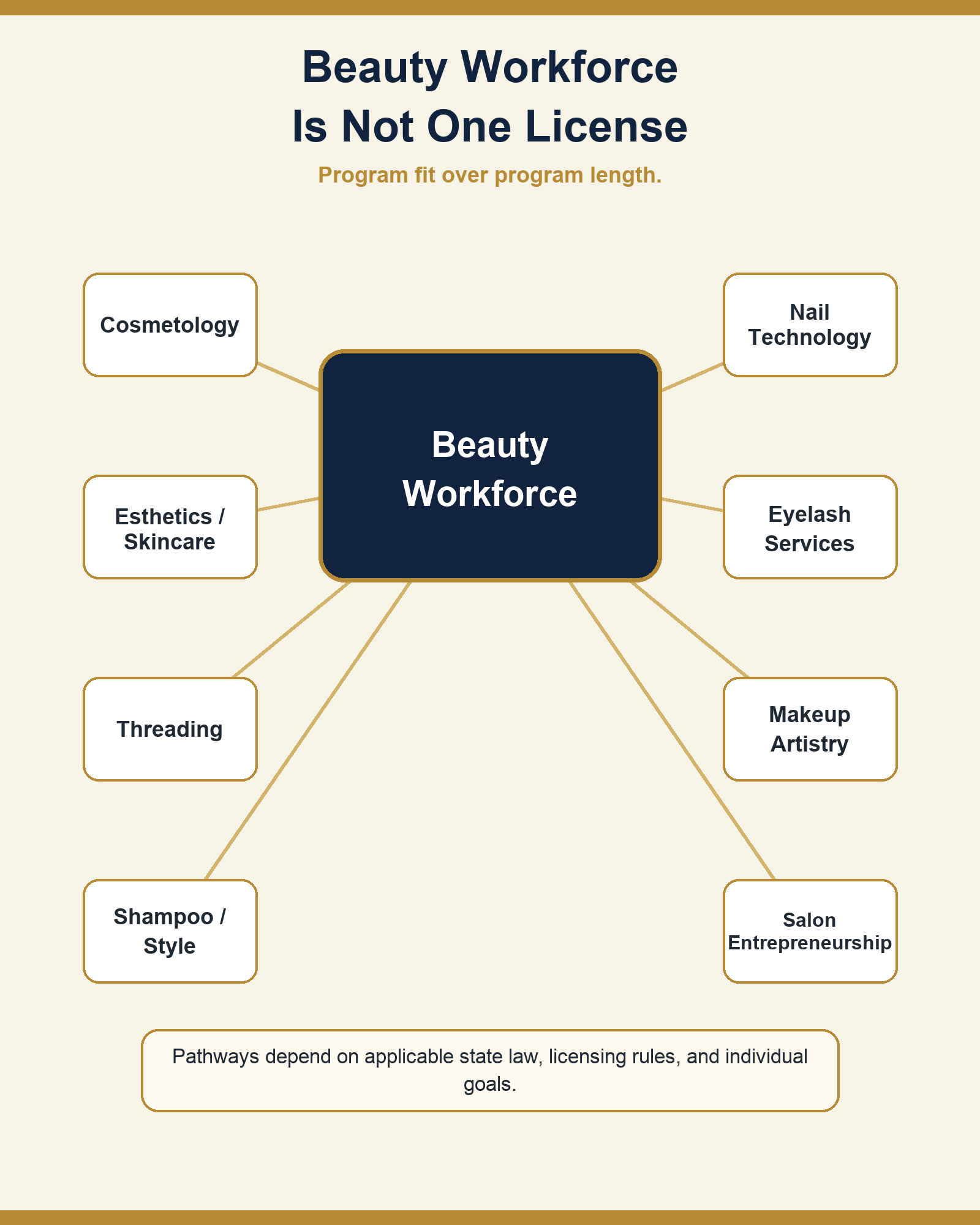
In beauty education, not every student is trying to become the same kind of professional. Some want broad cosmetology training. Others are focused on nails, skincare, eyelash services, threading, makeup artistry, shampoo and style, or a small specialized service business.
Clarity can reduce burden
When students understand the lawful pathway before enrolling, families can make better decisions about time, cost, transportation, childcare, work schedules, and support needs.
This is why program fit over program length matters for student support. A clear map can help a student avoid unnecessary burden while still respecting public safety, licensing rules, and professional preparation.
Support the student, not just the seat
Louisville Fund A Student Foundation’s role is to keep the human being visible: the parent trying to return to work, the immigrant learner building a trade, the adult student balancing family obligations, and the future small-business owner seeking a practical step forward.
Not every student needs the same road. Every student deserves an honest map.
Beauty workforce education should begin with pathway clarity: program fit over program length, within applicable law and licensing rules.
This founder reflection is preserved because LFAS is built around an others-first student-support ethic: community generosity should become practical access, dignity, and stewardship. The current LFAS website now separates that values story from active donation, student inquiry, privacy, and transparency pathways.
This article is not a scholarship offer, fundraising commitment, tax statement, legal statement, or promise of any educational, licensing, employment, financial, or personal outcome.
Current LFAS Support Path
This legacy article is preserved as part of the Louisville Fund A Student Foundation public record. For current student-support, donation, stewardship, privacy, and transparency guidance, use the updated LFAS trust pathways below.
LFAS does not promise or guarantee scholarship awards, admission, graduation, licensure, employment, tax treatment, financial results, or any specific outcome. Support is considered within available resources, documentation, stewardship standards, and applicable nonprofit boundaries.
Drop the “ME” and Focus on the “OTHERS” – by Di Tran, CEO of Louisville Fund A Student Foundation (501c3 – Non-Profit Organization)
From the time I was a kid through the present, I have always announced that I was the luckiest person in the world, to have been born by and well cared for by my parents, especially my mom, the number one “other” in my life. I believe that it was God’s plan for me to exist and to give me such a special mother, who was been a teacher, an idol, a mentor, and a great caretaker. She made the most of the worst and gave me the best out of life. She looks like a simple woman, small and short in physical stature, and easily underestimated by many. But oh-my-lord, is she ever inwardly explosive when it comes to the good deeds she wants to create for her family, her extended family, and her community! So, this kid from Vietnam, from the rural countryside of a third-world nation, understood the bad conditions he was living in, but never felt it because of the vast amount of love and care that he received from family members, and especially Mom. I learned to recognize one thing from all my experience up to this point: What you do for others is all that matters and nothing else, so we must choose to always provide the best and most valuable opportunity for others that we possibly can.
There’s a saying that my mom always tells me, “Son, a piece of bread that is given to a person when he is hungry is worth more than a big meal given to one who is full. One dollar given to those who do not have any money, is worth more than thousands of dollars given to those who have enough.” The consistency in giving and adding value to others in need is worth more than a one-time large gift. “Son, there is an element of self-satisfaction, self-happiness, and self-motivation that this involves.” She stressed that acts done for others are hundreds of times more self-satisfying than doing for oneself; be others focused. Growing up, I watched her give gifts to everyone who came by our house. There was a potato, her only food, which she cut in half and gave to a biker who rode her around. When there was a bag of bananas, she immediately distributed one to each of her team members. People, in turn, often gave her giftbags of fruit; however, these never lasted more than an hour before she had already distributed it. I watched her give without much thought, carrying out a “must do” mission, even when she had very little. I grew up watching Dad get angry because of these actions. “Damn it, you keep giving everything away, and not keeping anything for our family to eat. Give it some thought next time,” he yelled at Mom in a behind-the-scenes conversation that I often overheard. Interestingly, each time she would smile and respond, “Dad, they need it more than we do.” Of course, Dad did cool down, but he could not stop her from giving away whatever she had.
As I better understand this now, I call it “human engineering to happiness” from my personal perspective. According to books such as The Power of Your Subconscious Mind by Joseph Murphy, I learned that it is like brainwashing ourselves. It involves training our subconscious mind, the main part of our brain that reasons and pushes us to do everything we do, even when we don’t know why. In this case, Mom brainwashed herself and others around her, and so I was trained and witnessed and experienced this (brainwashed) via Mom’s giving as a guiding principle of life. This makes the action of giving easier than most tasks that I deal with in life. And once I lived through the happiness of giving unconditionally, I untapped a compulsion to do it more. Interestingly, the same results have occurred throughout my life, as my experiences duplicate those of her life. That is to say that people around me started to give things to me in services, products, assistance, and mentorships. “You cannot give without first focusing on others and being less worried about yourself, Son. “The more you give, the more you gain in return, often from other sources,” Mom explained.
“Expectation is the source of worry, unhappiness, and uncertainty. That’s why giving unconditionally matters more, because that’s when you give without expectation,” Mom explained. No expectations give the human mind the freedom to enjoy the giving experience and seek happiness in other people’s happiness when they receive your gift. This fact was confirmed by Dale Carnegie in his book, How to Stop Worrying and Start Living. What is of greater interest to me is that Mom always acted, and then explained her actions to her children. Often, she would take us with her on business trips, so we could witness her activities and see how she treated other people when making business deals. Mom is not the type who speaks theory; rather she acts on the theory and then explains it using examples of her actions. Throughout my life, this resonated the most with me; actions speak louder than words. “Do it first, Son. Do it. For anything you think is good for others, do it first, and then explain it. If you make one person happy through one action, do it again for many, and then increase that each day forward. Trial and error. I learned through doing.” I watched her read a lot, but these were always technical books and business product and service books; they were never books about theories of life principles. “To learn and not act is useless. It is worse than those who never learned. Once you know, you must act on what you know.” Mom pushed our boundaries of thought on this topic.